
The hotel manager at Namchi had organised a four wheel drive vehicle for us to go to Ravangala. We wanted to take the route via Temi tea garden; we had been told that the road that way was in bad condition. Getting a shared jeep did not seem to be a viable option. It was great having a massive car plus driver to ourselves and we luxuriated in the space.
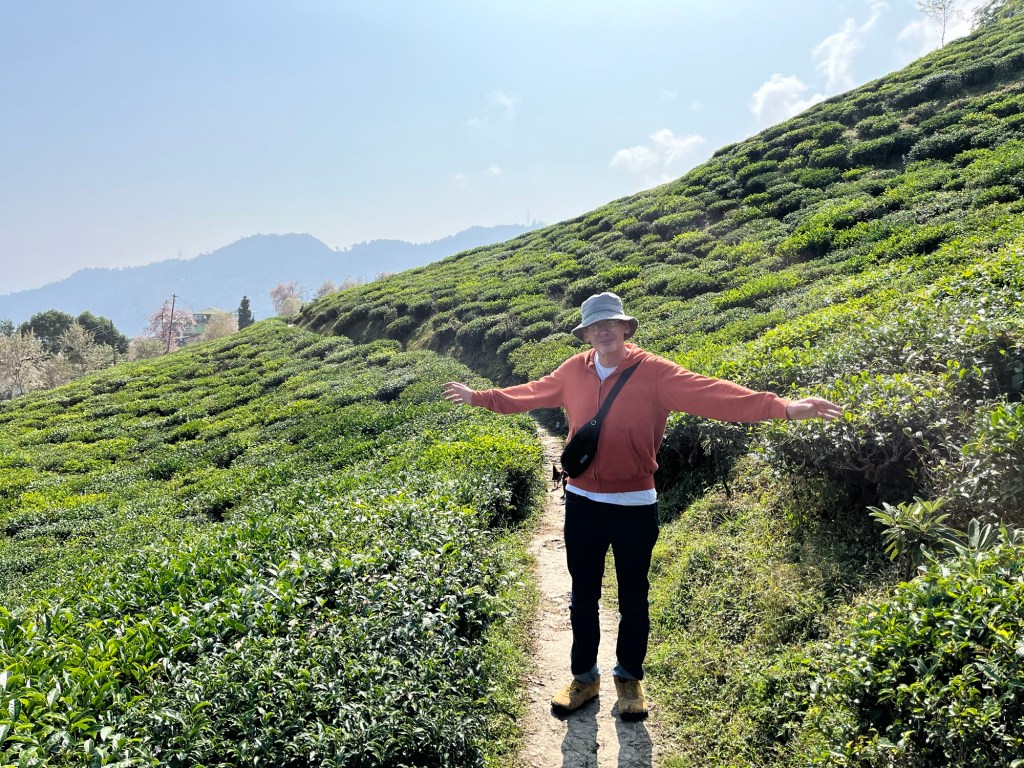
The road as far as Temi was pretty good. There wasn’t a lot to do there other than wander around the tea fields taking photographs of the lush surroundings. The cherry blossoms provided bursts of frothy pink amidst the green. They were just past their peak, but still very beautiful. We were told that the tea cultivation is all organic. Our driver drove us down from the tea gardens to a beautiful old colonial era house where many cherry trees were in full bloom. The manager was welcoming and happy for us to take photos. Given the luxurious surroundings the accommodation was very reasonably priced – about £80 per room per night. I was sorely tempted to book up for a treat, but staying in Temi wasn’t part of our plans. This did get me thinking that we should book into a heritage hotel at some point, for the experience, though.
We noticed that there were many jeeps and cars on the road carrying groups of schoolchildren. Some were picnicking at Temi and at other points along the road. Our driver told us that it was ‘Children’s day’ in Sikkim. Schoolchildren get dressed up and go out on picnics. Everybody was in high spirits.
After Temi the road seriously deteriorated and we were very glad of the four wheel drive. ‘This road is haunted,’ our driver told us as we veered perilously close to a vertiginous drop. ‘Nobody drives on it at night.’ I couldn’t help thinking that even if it wasn’t haunted driving at night here would be a death sentence. Maybe that’s where the ghosts came from. As we drew closer to Ravangala our driver pointed out a massive scar on the landscape – a huge landslide. He told us that many people had been killed and many houses destroyed, another reminder of how fragile the landscape is and how climate change is wreaking havoc in this area.
Eventually we arrived in Ravangala. The driver dropped us at Buddha Park. The focal point is a giant statue of Buddha. According to Wikipedia the statue is 40 metres high and was erected to mark the 2550th anniversary of the birth of Gautama Buddha. It is built of 60 tonnes of copper. Photographs are not allowed inside as it has the status of a Gompa/ Temple. I found the display within even more awe inspiring than its imposing exterior. It is designed in a clockwise spiral with intricate art illustrating the different stages of the Buddha’s life. At the very centre of the spiral are relics that have been presented by Buddhist monasteries all over the world. People were having a fun visit, including groups of young monks visiting for children’s day. However, there was also a very tranquil and spiritual atmosphere, especially within the Buddha. Once again we were unlucky with the weather, with the mountains that surround the site obscured by clouds, but this did not spoil our enjoyment. We ate momos at one of the many stalls at the entrance to the park before re-joining our driver to head to our homestay.


The homestay was located about 20 – 30 minutes away on a winding mountain road, in a small village. The family welcomed us warmly and quickly offered us chai and snacks. We said goodbye to our driver and settled in for the night.
 Kate's Travels
Leave a comment