
Our taxi was waiting to take us from Pelling to Yuksom at 9am. We called in at the SBI cash machine before leaving, as we had heard that there are no ATMs in Yuksom. Our cards seem to work best in SBI (State Bank of India) ATMs and they don’t charge a fee. I have a Barclays Credit card that also doesn’t charge, so all we have to pay is the exchange costs, which saves quite a bit of money on cash withdrawals.
Booking a taxi tour to Yuksom turned out to be a good decision – our driver stopped at some beautiful locations along the way, including Rimbi and Kanchenjunga waterfalls. We thought that Rimbi was magnificent, but Kanchenjunga, which came higher up the road, was even more thrilling.

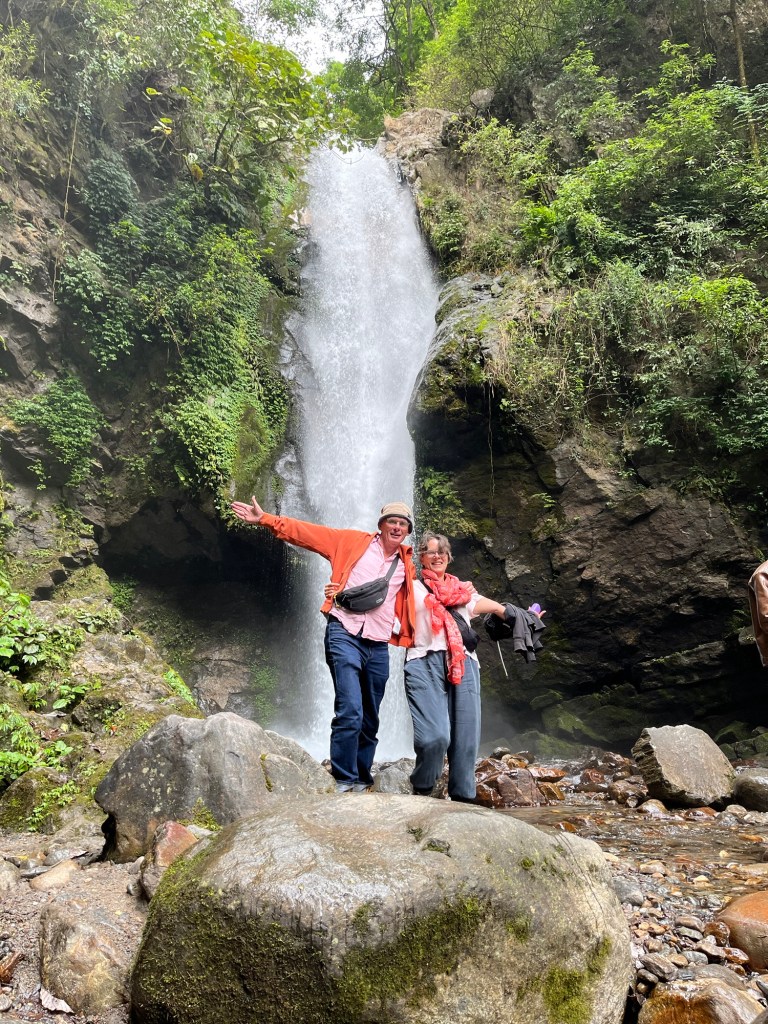
We also stopped at Rimbi Orange Garden, where orange trees, cardamons and other produce are grown. We sampled some delicious fresh orange juice. Local alcohol was also being sold, but we gave that a miss. We later heard about the sad fate of several backpackers in Laos and were glad that we stuck to the juice! It felt a lot warmer in this lush valley, where we wandered by the fast flowing river. We noticed several homestays and fantasised about returning one day. I noticed lots of poinsettia growing in the forest.

We crossed the river at a bridge festooned with Buddhist prayer flags and arrived in Yuksom. It is the starting point for the Kanchenjunga trek and the furthest western town in Sikkim. It is spread out along a main road with a small central area that has minimal shops and cafes.
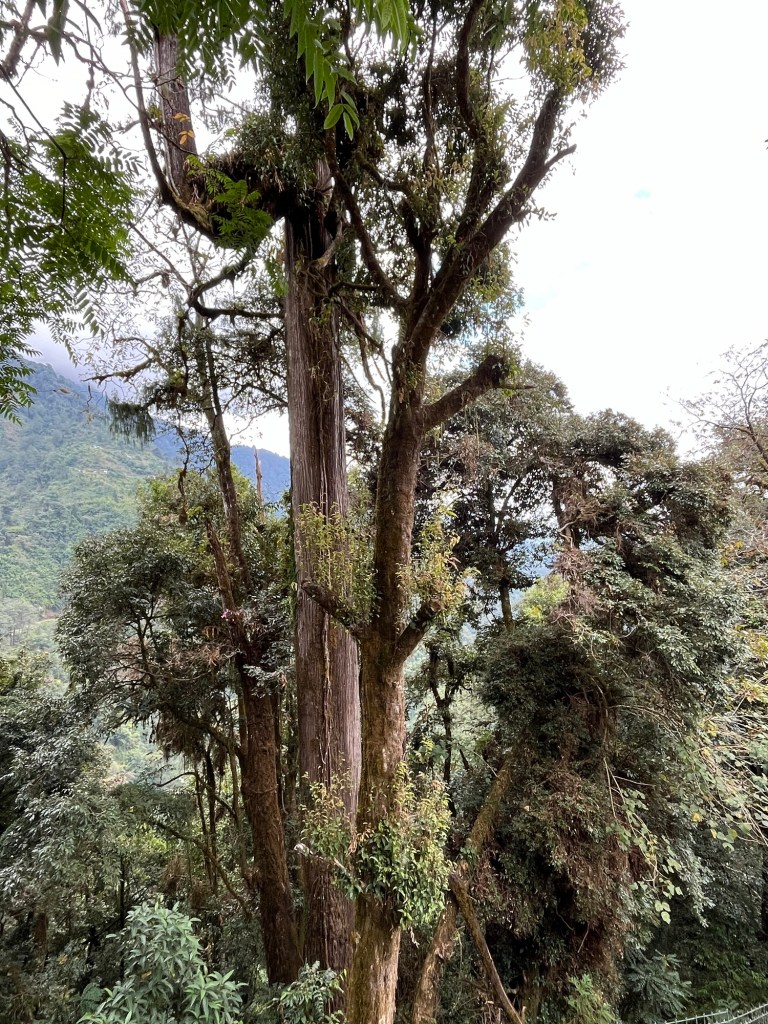
The taxi driver took us up to visit the local sacred lake and Dubdi Monastery. I think that this, together with Sanghak Choeling Monastery in Pelling, was our favourite monastery in Sikkim. Like Sanghak Choeling, it was small and peaceful. It was surrounded by magnificent old trees that stretched into a canopy high above us. I have never visited the redwood trees in California, ( I hope I can one day) but they reminded me of pictures I have seen of them. We spent some time wandering through the woodland and enjoying the atmosphere in the monastery before rejoining our driver.
He dropped us at the end of a bone shattering lane that led to our hotel the ‘Red Palace’. We later found out that it is owned by a Sikkimese man who is now a Bollywood actor. I think that we were the only inhabitants, as it is low season in Yuksom at the moment. We missed the electric blanket we had had at our previous hotel as it was quite chilly. Sadly, it was also cloudy the whole time we were in Yuksom, so we were unable to catch another glimpse of the mountains.
The Red Palace was a cavernous old atmospheric place with long empty corridors and wooden floors. Tim immediately started comparing it to The Overlook Hotel in ‘The Shining’ and freaking me out by making weird noises as we walked down the echoing corridors. I kept expecting a little boy on a tricycle to come riding round the corner. We had our first evening meal in the hotel, but the cooking wasn’t that great, although the breakfast that was included was ok. We fell into a routine of going for a walk and calling in at the one local cafe that seemed to be reliably open in the village to eat at around 2:30pm every day.
We met a couple of other travellers in the cafe, including a man called Taj who has been travelling for the last eight years, since he retired. He had just come back from completing the Kanchenjunga Trek. His pictures of it looked amazing and he planned to do it from the other direction in Nepal at some point. He had been lucky with the weather – even if we had had the time to do it ( I think it takes around 6 – 8 days) by the time we arrived it looked as though the winter snows were beginning to close in. He gave us some good tips on future places to visit, especially in India (he told me about a zen Buddhist retreat in South India that sounds just what I might need before returning to work) and gave us hope that with a pension travel can continue indefinitely. He was on his way to pick up an Enfield bike he is planning to tour round India on. He has also got plans to buy a camper van.
On one of our walks we visited the farm of ‘The Kiwi man of Sikkim’. I believe that we are now on one of his Facebook videos. We were amazed by this man’s energy and enthusiasm. He has been a local politician, participated in a locally made film and now tends his kiwi garden, fertilised by his three cows. We sampled his kiwis which were delicious – much sweeter and tastier than the ones we get at home. We also tried his cardamons, which when fresh have a very strong floral taste. The kiwis grew supported by a wooden trellis above us, like a grapevine.
We walked up to Dubdi monastery again on our last day in Yuksom. The monks were performing a puja with lots of members of the local community present. We got chatting to a local man who used to run a trekking agency. He told us that his daughter had recently moved to Surrey to work as a nurse after spending time working in Kolkata and Siliguri. The work in the UK is apparently a lot less strenuous than nursing in India. She is the only Sikkimese nurse in her group and has found it hard to make friends with local nurses; all her friends are nurses from India. We are so lucky in the UK to get the benefit of these highly trained and experienced professionals, who have the guts and drive to want to give working abroad a try. I hope that my fellow country people are doing all they can to make them feel welcome and at home, although I fear that sometimes this may not be the case.
 Kate's Travels
Leave a comment