
We spent four nights in Phuket and probably that was a little too long. The old town is gorgeous, but also very touristy. All the sights it contains could probably be covered in two days, We added one day on the beach and also had time to hang out in cafes and watch the world go by. Compared to the rest of Thailand we found Phuket quite expensive. On our first night we had a few beers and a couple of underwhelming snacks at a bar and ended up spending more than we had anywhere else in Thailand so far!
Luckily, like most of Thailand’s touristy areas, the high prices are concentrated in a limited area. We discovered that if we stepped one or two streets outside the main Old Town block, we were back to more usual Thai prices. Our favourite cafes became one in the local fresh market area and a restaurant run by refugees from Myanmar.
Many young people from Myanmar are living in Thailand. If they stay in Myanmar they are forced to join the army. The young workers in the restaurant we visited were wearing T shirts with pictures of Aung San Suu Kyi and Kyal Sin on them, including the quotes ‘Freedom and democracy are dreams you never give up’ (Aung San Suu Kyi) and ‘Everything will be ok, we remember you Kyal Sin’. Sin was shot in the anti coup protests in 2021 aged 19. She was wearing a T shirt with the slogan ‘Everything will be ok’ on it.
Phuket Old Town reminded me of Penang in Malaysia which we visited on our last big trip many years ago. Having said that Penang was a lot more run down and less touristy than Phuket is when we visited, but this only added to its charm. I suspect that it has now been ‘done up’ for tourists in a similar way to Phuket.
Tim read in an article that only about thirty per cent of people living in Phuket are local to the island. In common with other hot tourist spots like Barcelona, a lot of locals have been forced out as property prices skyrocket due to tourism and ex pats renting out properties. There are many Russians in Phuket currently as well – some escaping involvement in the war in Ukraine and others holidaying – Thailand is one of the places where Russian tourists are still welcomed. Ukrainians as well are Russians are present in Phuket and apparently there have been no issues between them – in fact relations are said to be very cordial. There are varying reports of Russian mafia activity on Phuket. I believe there have been a few Russians found murdered, but Thai police state that the situation is under control. We certainly did not experience any issues.
We met a Russian family on the bus on the way to the beach who were very charming. We heard that taxis are very expensive due to fixed prices by the local ‘taxi mafia’. In fact, when we left the island we used the ‘Bolt’ app and it was very efficient and reasonably priced – we wished we had tried it earlier. There are buses and Songthaews that run to the beaches from the Old Town, but they tend to go from the old town to individual beaches rather than calling at the various different beaches.
We decided to visit the busiest beach, Patong for our day by the seaside. The town is full of loud bars, restaurants, night clubs and brothels and the beach was packed – sun loungers were arranged in sections with breaks to allow safe operation of jet skis and other beach activities. I went for a quick swim, but the water didn’t seem very clean and I later read that it is indeed very polluted due to the sewage system not being able to handle the high number of hotels. I am sure if you wanted a party holiday it might be enjoyable, but one day was enough for me.
I believe that some of the other beaches on the west coas of Phuket are much cleaner and more attractive – we did pick the busiest one to visit at high season, so maybe there are much better areas to chill out and sunbathe. We also noticed that there are lots of private resorts that have their own beaches – I guess that is what you may experience if you go on a package holiday, which might be a very different experience to spending time on the public beach. Tim and I tried to sneak into a posh looking resort at the end of Patong beach, but it was well guarded.
The other thing we didn’t do when in Phuket is go on one of the many trips you can take to visit places like Ko Phi Phi and ‘James Bond Island’. Tim had been to Phi Phi many years ago before it became a national park and entrance was restricted, so he didn’t feel the need to return again. Although the trips are not too expensive if you are visiting for your once a year holiday, we are on a tight budget as we want to be able to travel for as long as a possible, so we gave them a miss. We had also had our paradise island beach experience already on Ko Phayam. We did meet several people who recommended the trips to us as the best experience they had in Phuket, however.
I read about the recent history of the beaches of Phuket. From being a hippy paradise in the 1970s and 80s with a few bamboo huts it has now become a major contributor to the Thai tourist industry. Is this the way Ko Phayam will go? I hope not.
The old town museum and Thai Hua Museum were both fascinating and we spent a happy few hours looking round them. Both museums recount the history of Phuket, particularly the history of the Chinese community there and Phuket’s links with Penang and Singapore. The Chinese came at different points for various different reasons – to escape poverty and famine in China and to work in the tin mines. They then intermarried with local people becoming known as ‘baba’ if boys and ‘yaya’ if girls. Phuket has also experienced migration by Europeans who were involved in the rubber and tin industries and built some of the mansions scattered around the old town in particular. The architecture is an interesting mixture of styles. Phuket is an island of migrants and although the museums did not mention this, continues to be with the next generation who have arrived from Myanmar.
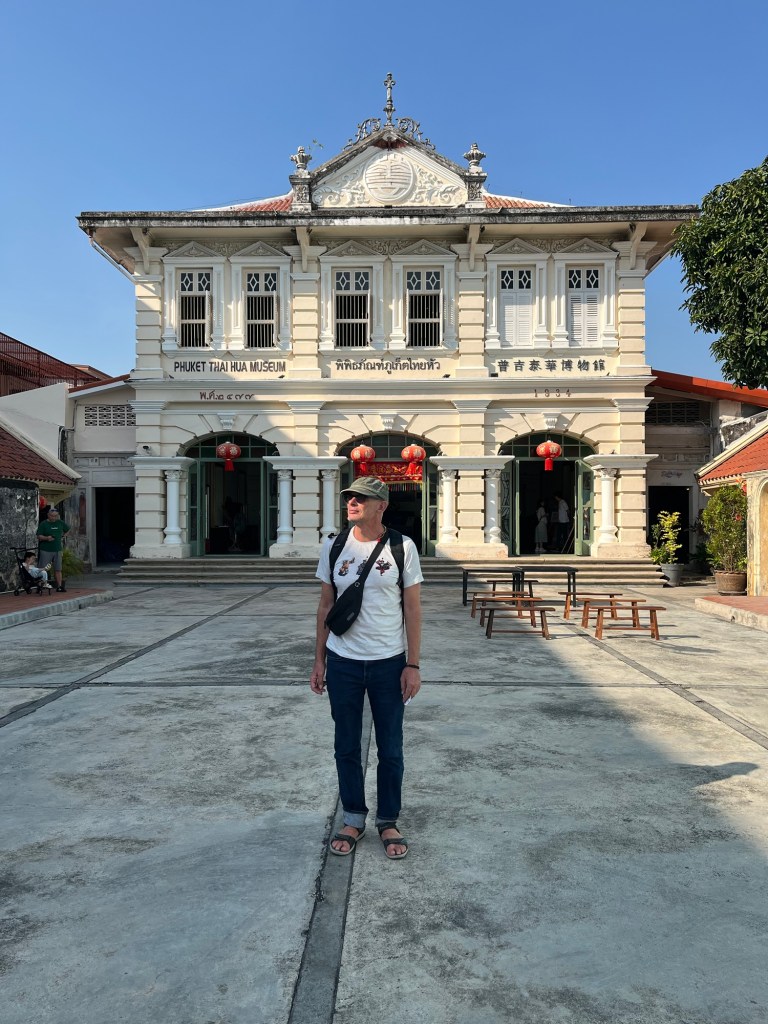
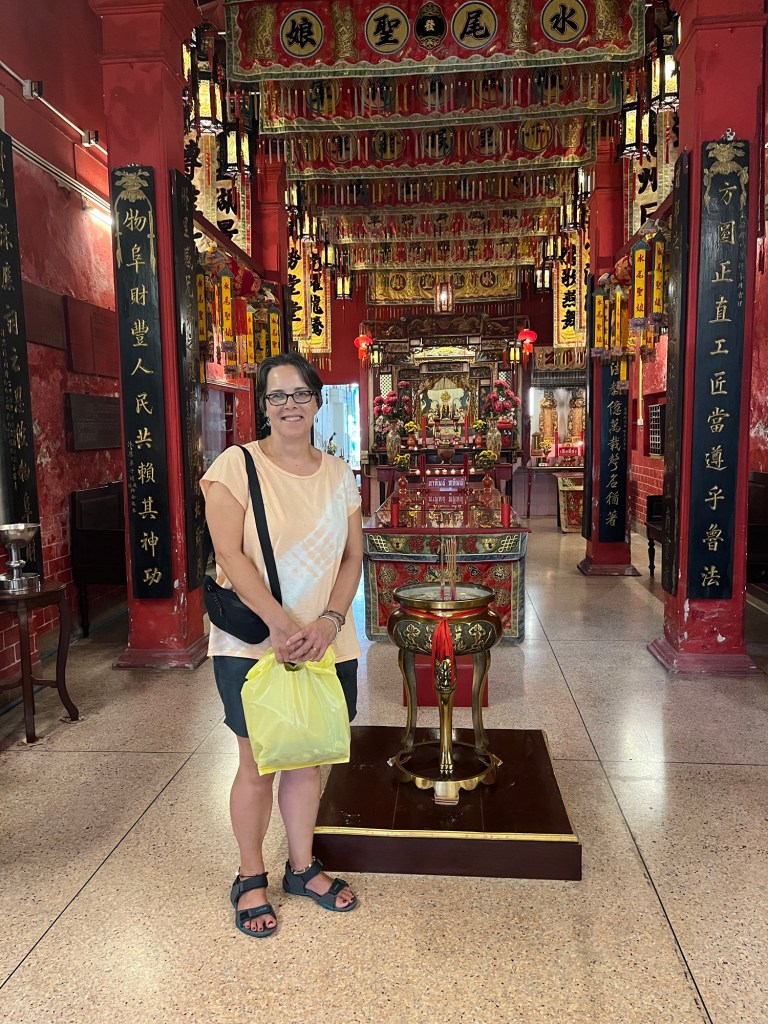
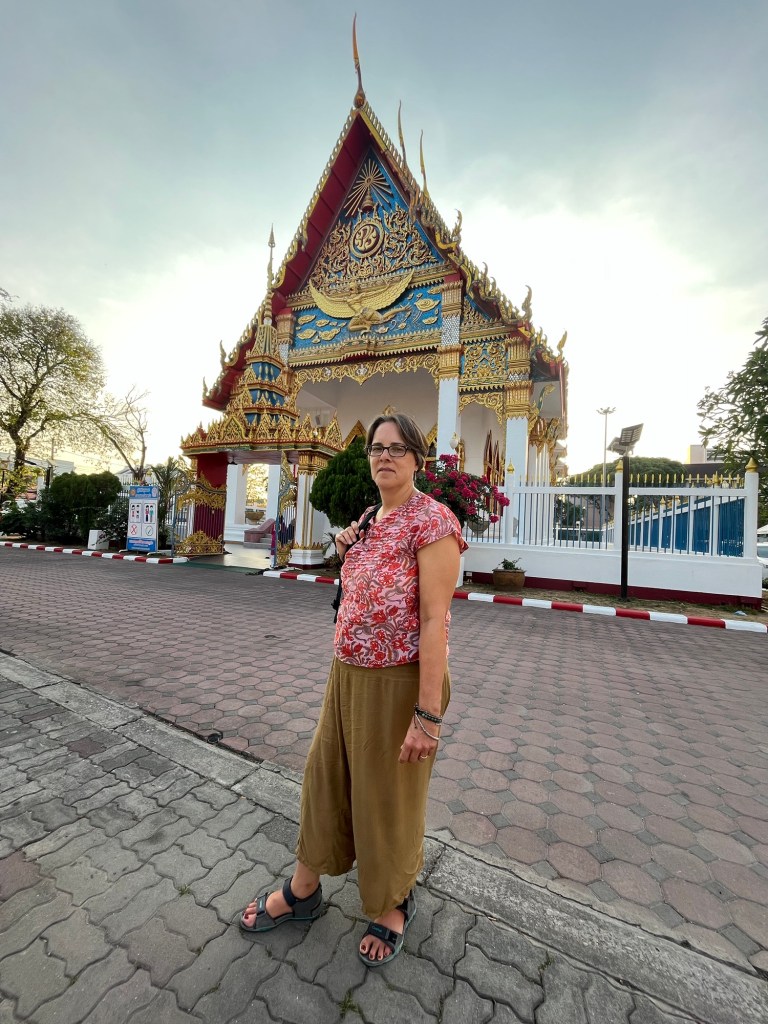
There is an old Chinese shrine hidden among the buildings in the old town that is interesting to look around. We also visited the local Buddhist temple on our last day. We arrived at about 6pm and just as we were looking around the monks entered and started their evening chanting. It was a very serene experience in contrast to the busy tourist scenes just outside the compound.
The Phuket ‘walking street’ market was operational on two of the nights we spent in Phuket. There is a regular Sunday ‘walking street’ Old Town market, but on Monday night, the day before we left, there was a special ‘walking street’ market with additional performances and covering a wider area. This was held as part of the annual Phuket festival. Both ‘walking street markets’ were similar to the one in Ranong, but with a lot more tourist focused goods on sale. The entertainment was of a slightly more professional standard than that in Ranong. The ‘waking street’ market and the old town in general is a hot spot for insta-grammers and influencers. It almost put me off posting anything more on social media! At one point we saw a couple of girls who had gone and bought a whole basket of flowers as a prop to post with on Soi Romanee. This is one of the most street famous streets in the Old Town. It used to be full of brothels that sailors stopping off in Phuket would frequent.
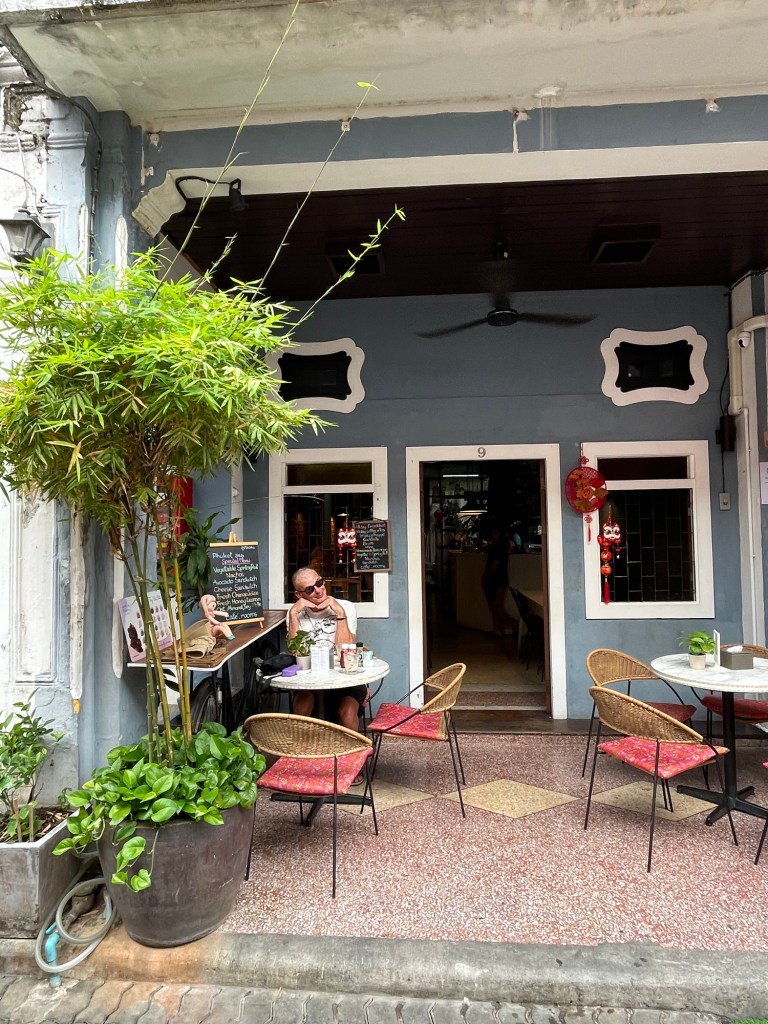
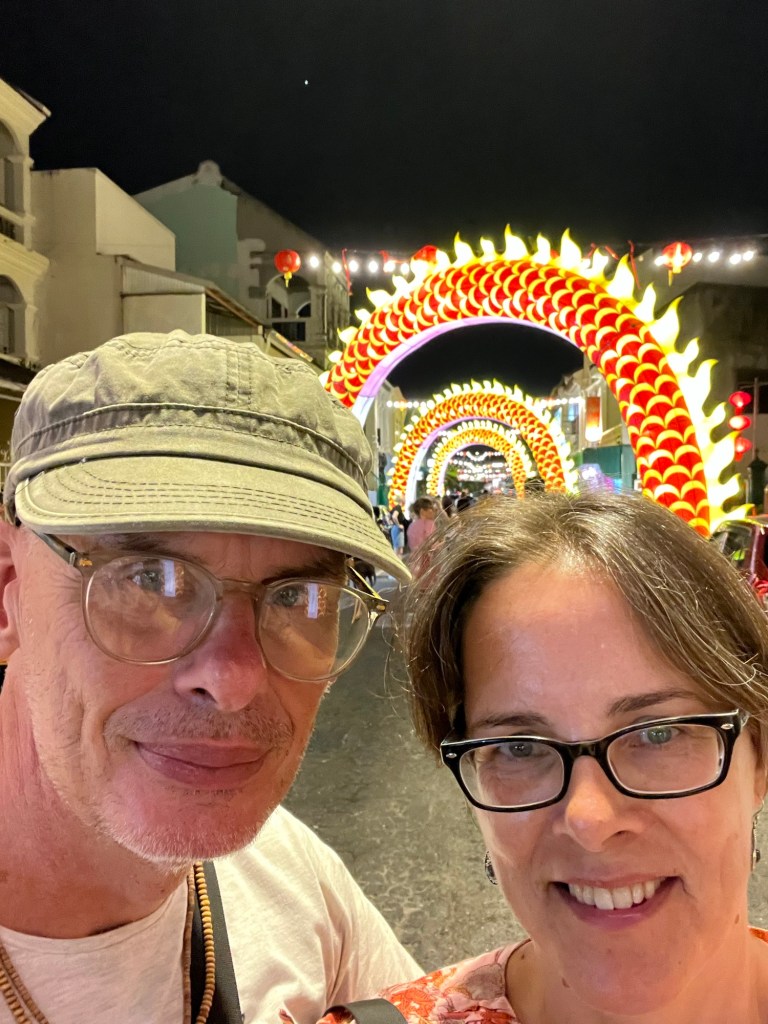
On walking street with dragon decorations for Phuket festival in backhground
We left Phuket for Bangkok early on the morning of Tuesday 4th February, heading back to the bus station for our thirteen hour ride. From here we are on our way by night train first to the north western Thai town of Udon Ratchatani and then to Pakse in Laos.
 Kate's Travels
Leave a comment