
It is an easy six hour bus ride from Ubon Ratchathani to Pakse in Laos. Formalities at the border are straightforward. We filled out a couple of forms and paid around £45 in Thai baht to get a visa on arrival stuck in our passport (this would have been cheaper had we paid in US dollars).
As soon as we crossed the border the countryside looked more impoverished. Workers from Laos use this border crossing to access work in Thailand. The elderly woman who owned the guesthouse where we stayed in Ubon Ratchathani told us that she is struggling now she is getting older. She said ‘Young Thai people want to work in air conditioned resorts.’ It is workers from Laos and Myanmar who are taking their place. There are concerns about people trafficking here as well as in Europe.
Pakse is another pleasant Mekong town, although it has a different feel to Ubon Ratchathani. The Chinese influence is felt in some of the grander buildings, shops and cafes. Laos is in very significant debt to China. Google tells me that their overall debt is 108% of their GDP, half of which is owed to China.
We spent our first evening wandering the Mekong waterfront where we found a ‘beach’ (well a small patch of Mekong sand). We ended up in a lively bar. Communal drinking and loud music is much more prevalent here than in Thailand, although the people seem more reserved and shy when we talk to them.

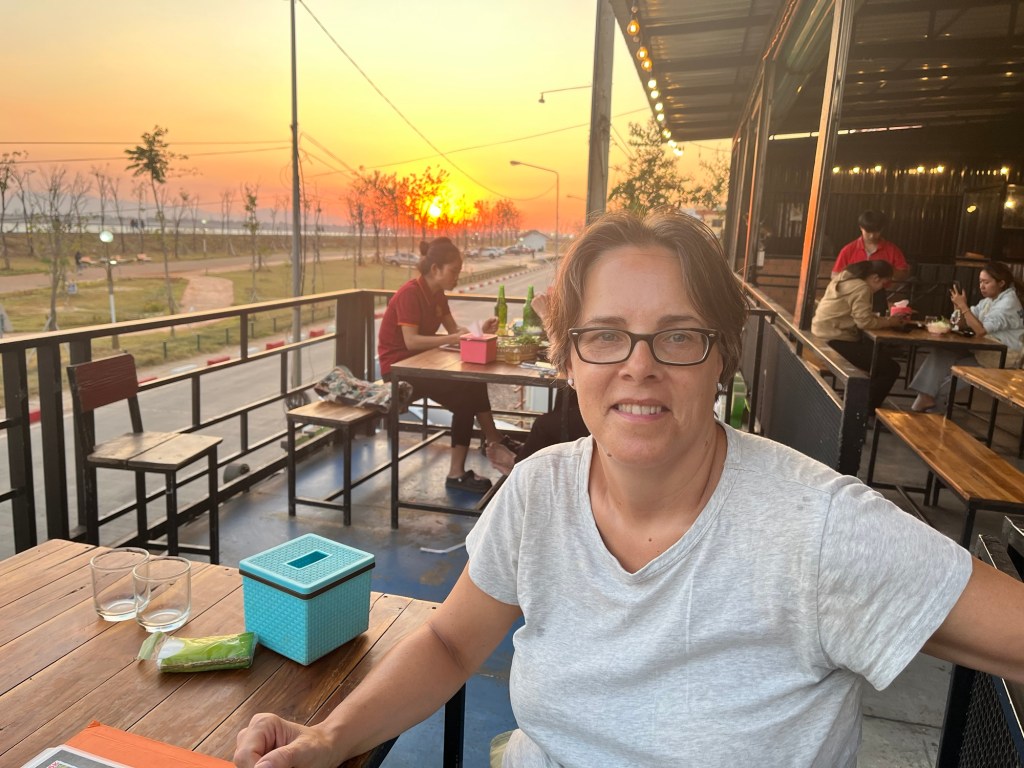
Bar on the Mekong
It is clear that we are on the south East Asian backpacker route. The hostel we stayed in is in the centre of the tourist area and everywhere we looked there were offers for tours and trips to anywhere backpackers would wish to travel. I have to admit this does make everything a lot easier than trawling the internet or going and getting tickets at bus or train stations.
We quickly booked our onward transport to Don Det island on the Mekong (air con van, ferry crossing included) and a day trip to the Bolaven plateau, which is an area close to Pakse. Many people do this trip on hired motorcycles. We thought that we had booked a minibus tour, but it turned out to be a taxi with just one other tourist, Martine from France. She told us she lived in London (West Hampstead) when she was younger and had done lots of south East Asian travel in her youth. I was soon reminiscing with her about London in the late eighties and early nineties and Tim was swapping stories about Thailand, Cambodia and Vietnam from the same period.
The countryside we drove through was underwhelming but we did visit two magnificent waterfalls. We also stopped at a ‘tribal’ village. I wasn’t sure if it was tribal – it just seemed very poor to me. It is a popular overnight stopover for tourists that hire scooters. I had seen too many foreigners in Thailand with ‘Thai tattoos’ – scars from injuries caused by scooter accidents to want to risk doing the trip this way.


There was a small entry fee to get into the ‘tribal’ village. Two entrepreneurial families were offering home stays and village tours. It reminded me a bit of villages in northern Laos we had visited back in 2000, but more downtrodden. I talked to the woman who owned the homestay and who made us some delicious lunch. She said she was from another village originally. Inevitably the homestays have caused some tension and jealousy, hence the entry fee presumably so other villagers can share in the money brought in (unless it goes to the local government, which is possible…). She said she had 48 foreigners staying one night which seems a lot!

We passed several coffee plantations. The climate in the Bolaven plateau is apparently ideal for coffee. I tried some – it is ok but quite sharp tasting. I am no connoisseur of coffee though.
That evening we found a restaurant run by an Italian serving delicious traditional Italian fare in a beautiful garden where we treated ourselves before our journey to Don Det the next day.


 Kate's Travels
Leave a comment