
Our plans after our visit to Ho Chi Minh City were vague. Ideally we would have travelled further south but the weather wasn’t looking good. We were heading into the rainy season. As our flight home is from Bangkok we decided to go to Thailand instead.
We were in a quandry about whether to head to Chiang Mai in the north of Thailand or Ko Phangan in the south. Although most of Thailand is experiencing the south-east monsoon at the moment, Ko Phangan is in an area that is only mildly impacted compared with the rest of the country. It experiences its worst weather in November when the north-east Monsoon hits.
In the end we decided to risk heading north. I have wanted to visit the Chiang Mai area for a while, but the time has never been right. We spent an uneventful day travelling by Vietjet to Bangkok and on from there to Muang Chiang Mai (muang means city).
It had just finished raining heavily when we reached Chiang Mai city. We dumped our bags in our rather nice hotel, which we had got at a discount rate due to the season and went out to explore. The waiter at the cafe where we ate told us that the Inthakin festival was happening at Wat Chedi Luang, just down the road, so we went to explore. From what I read online the festival is to celebrate the beginning of the rice planting season. It involves making offerings so that the rains will be good. They already seemed to be working!
It was the last night of the festival, which goes on for several days and the wat was packed. Chedi Luang is one of the oldest and most significant wats in the old town. It has a massive central stupa which partially collapsed during an earthquake. The temple underwent reconstruction in the 1990s. The Inthakin festival centres on the city pillar which is located in the grounds of the temple, which are extensive.
We watched as water was hauled up in containers and splashed onto the sides of the stupa. Inside the wat lots of merit attaining activities were happening. People were giving money to buy coins that they then distributed between lines of receptacles. They were also purchasing gold leaf and attaching this to a line of statues.
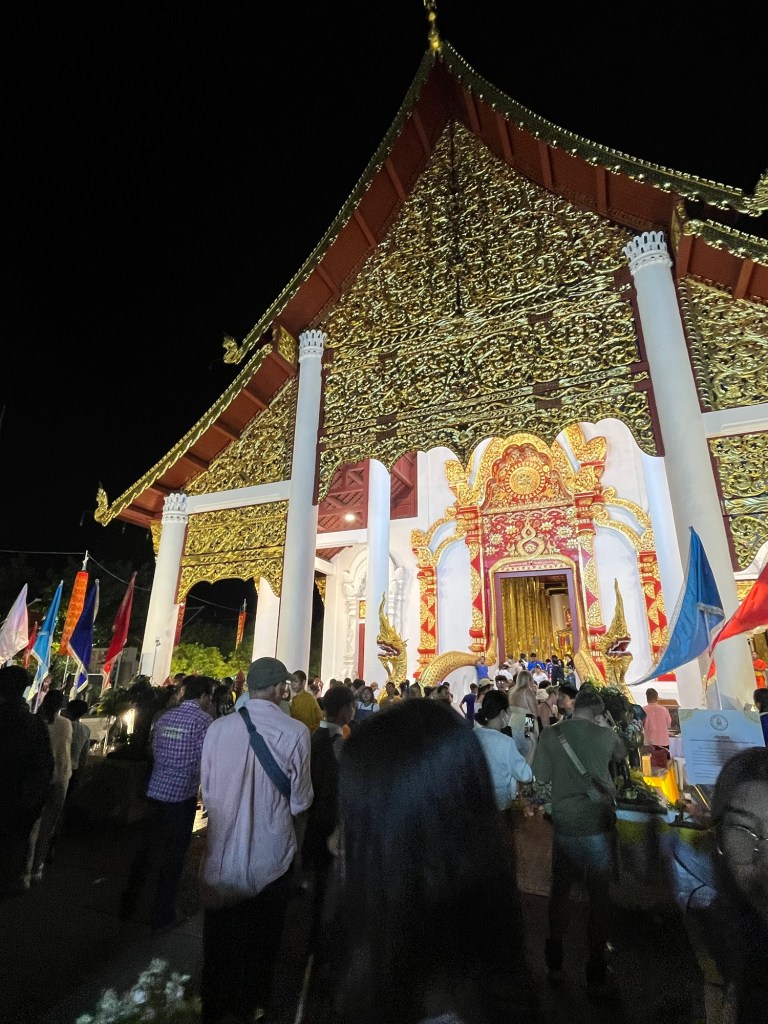
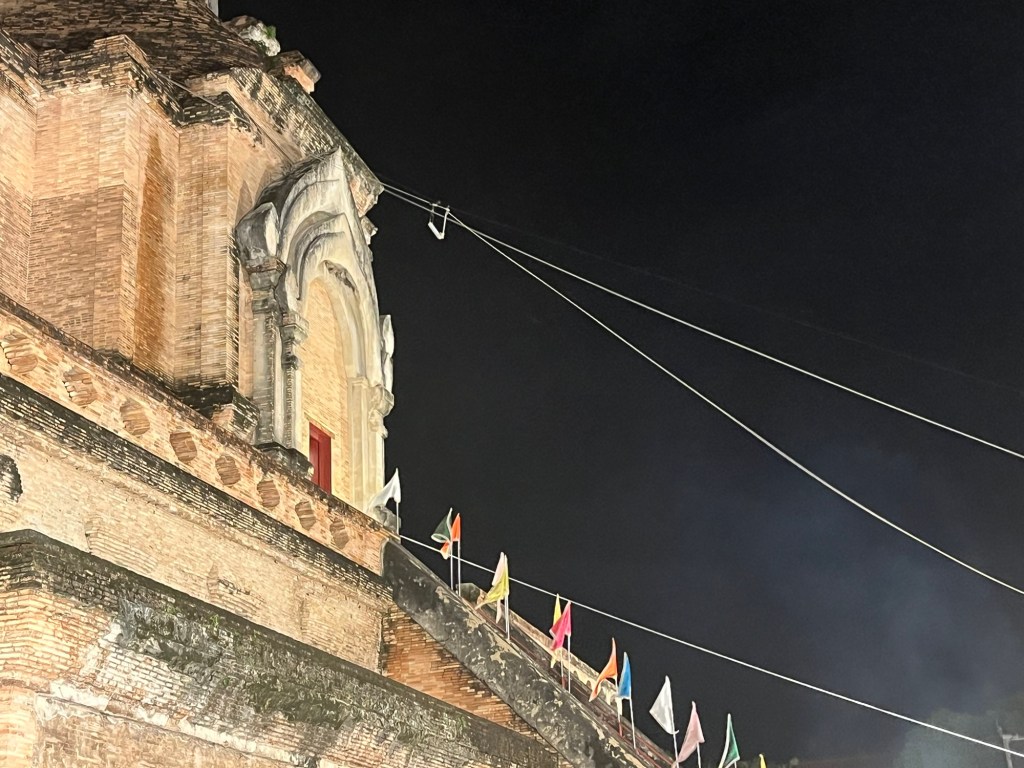
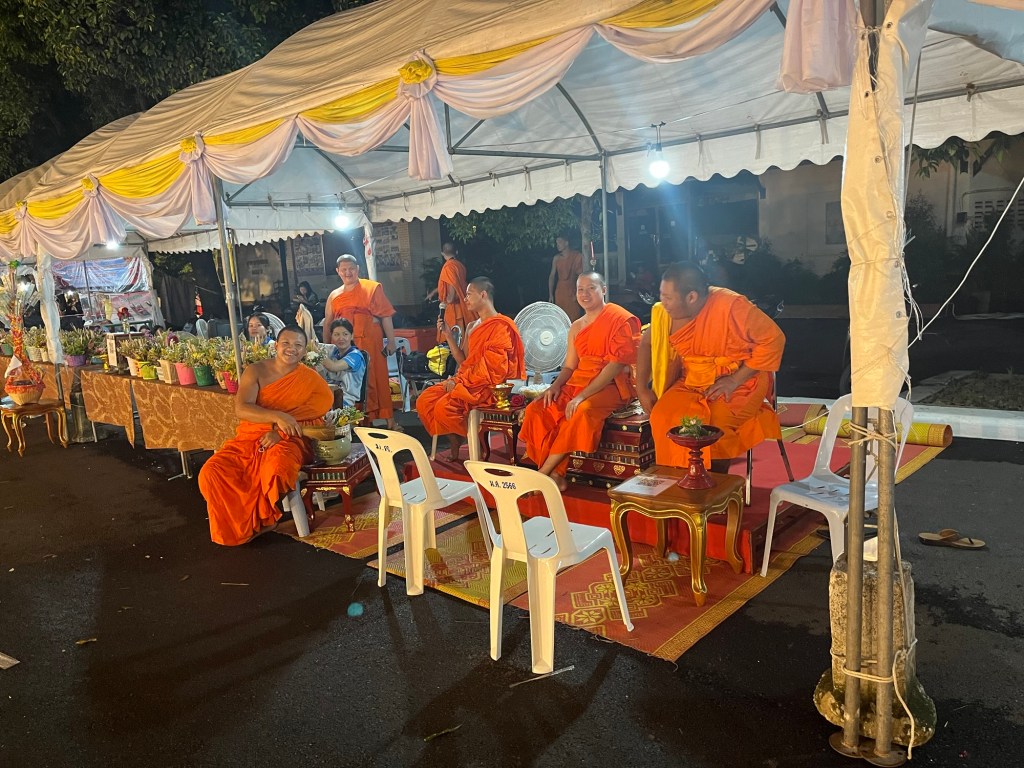
Outside, various musical and dance performances were going on and people were selling food, drink and gift items. The most exciting performance was that of first a solo young man and then a group of young women who danced holding two long sharp looking knives each (I have put a clip of this on social media). Everybody was out with their families, looking excited and happy. It was a lovely atmosphere to be part of.
The next day we wandered around some of the temples in the old town. Although it was hot, the occasional downpours cooled things down a bit. I imagine that although the weather at other times would be better, it might get very crowded.
We found out that we had just missed Chaing Mai city’s Pride Festival. Apparently it is the only one in Thailand.
Chiang Mai city is known for its art. We visited a private gallery called MAIIAM. They had some brilliant exhibitions on, featuring artists who were coming to grips with the legacy of colonialism and environmental destruction. A funny but thought provoking film by Vietnamese artist Tuan Andrew Nguyen featured a discussion between the spirits of an extinct rhino and a turtle. It’s worth looking up his work on instagram or online if you are interested.


I also found a film by Liu Chuang (from China) really gripping. It looks at environmental destruction and the impact of modern technology on communication, including in relation to the dying languages of indigenous peoples. It features a supercomputer sent from somewhere in space, disguised as a woman, to survey earth. Issues related to dams and lithium mining are covered in a very imaginative way.
A painting based on Guernica (pictured above) relates to the ongoing conflict in Myanmar. There was also a film by Khvay Samnang from Cambodia based on dances of the indigenous forest-dwelling Chong community (see masks that are used by the Chong pictured above).
These exhibits felt much more future focused and political than the exhibitions I have seen recently in the UK, which have all been retrospectives.
We signed on to a tour to visit two wats on the outskirts of town that can be reached by a route known as the ‘Monk’s walk’. Our guide was an ex monk. He gave us lots of information about the wats that we wouldn’t have been aware of if we hadn’t been with him.
The walk up to Wat Pha Lat was fairly easy although we were glad of the mosquito repellent that we had covered ourselves with. It was a very peaceful set of buildings in the middle of the jungle.
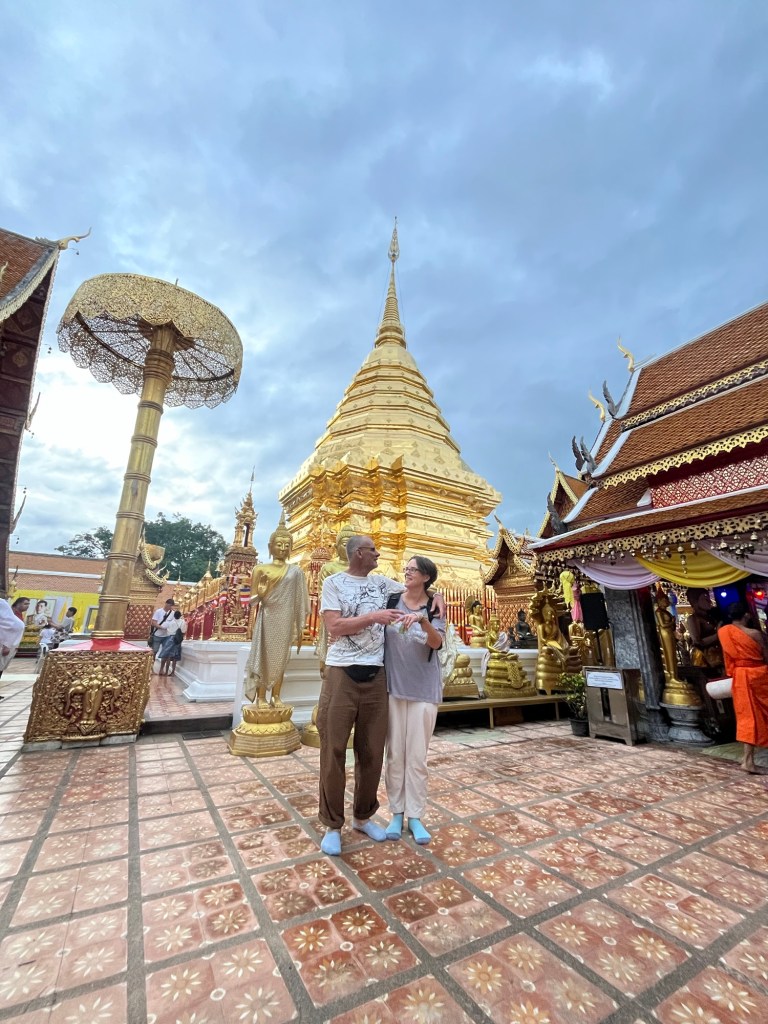
Our guide had arranged a songthaew to take us up to the other wat – Doi Sutep. I believe that it is possible to walk up there but it is a tough, long trek which I wouldn’t have wanted to do at this time of year, even in the cooler evening temperatures. The monks were preparing for the birthday of the Queen the next day. Our guide explained that different days of the week are associated with different colours in Buddhism and the temple was being hung with the Queen’s colour, purple. The next day a number of local dignitaries were due to visit. It reminded me of how closely Buddhism and the wats are linked to the royal family and the government/ politics of Thailand.


We considered travelling to other areas around Chiang Mai like Pai or Chiang Dao, but in the end there was so much to see in Chiang Mai city that we decided to stay there for a whole week. We were feeling the need to slow down at the end of this segment of our travels.
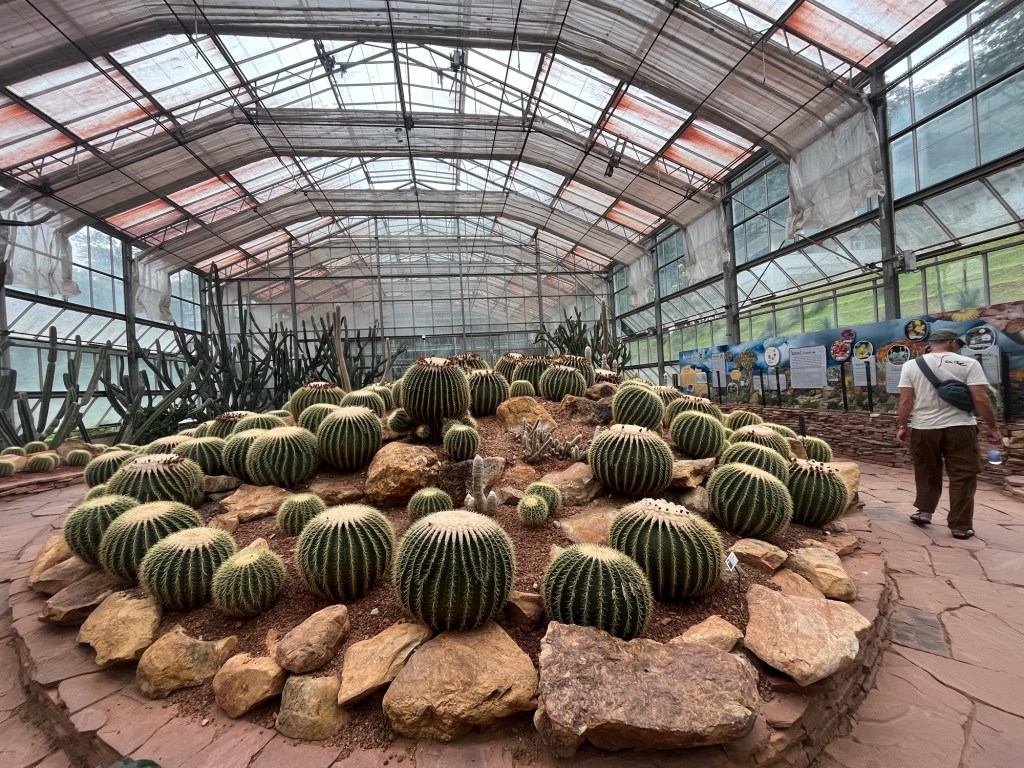
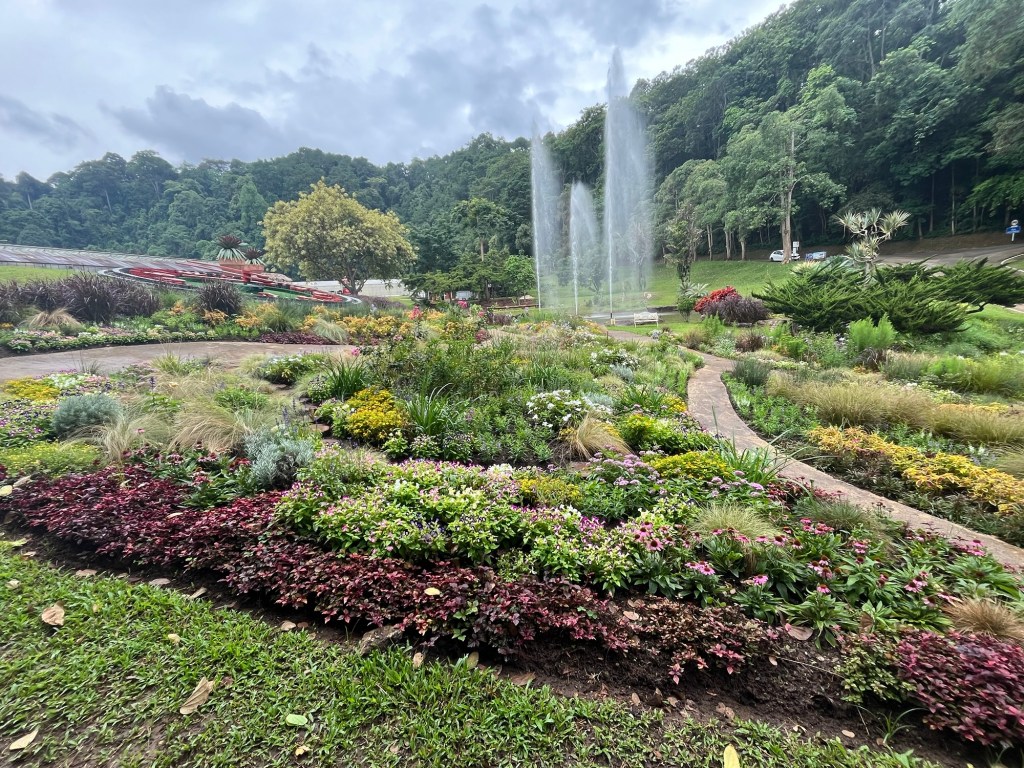
On our last day we visited Queen Sikirit’s Botanic gardens. This has a high walk above the forest and lots of greenhouses. It focuses on nurturing rare plants that are in danger of extinction, particularly orchids. Tim’s sister Jane would have loved it. She was a much more enthusiastic gardener than us.


We decided on Ko Phangan for our last week in Thailand. Waving goodbye to Chiang Mai and hoping to return to the area again someday, we headed back to the airport.
 Kate's Travels
Leave a comment