
We headed to Manali bus station at about 9am the next morning. The man in the booth told us that the next bus to Keylong would be leaving at 10:30am and that we could buy tickets once we had boarded. That gave us time to go and have some breakfast at our favourite coffee shop in central Manali that looks out over The Mall and the bus station.
A Dutch family were sitting on the table next to us. They had three children with them, aged 16, 14 and 5. The Mum spent some time during her training as a doctor on a placement in south India and they had been hoping to get back to visit since having kids. After chatting a bit it transpired that they were planning to do the Chandrakhani pass trek as a family with IndiaHikes! They had done some hiking in the alps the previous summer and were fairly confident that the kids would manage. I tried to imagine doing a trek with my kids when they were similar ages and failed. We may have possibly had a small window between the ages of about 9 and 12, but 14, 16 and 5 – not a chance!
We arrived back at the bus station later than we planned after our interesting discussion with the Dutch family. It was already crammed with passengers and we began to doubt that we would be able to squeeze both ourselves and our backpacks in. At that moment we were approached by a man offering a shared taxi ride for a reasonable price to Keylong, so we jumped at the offer, knowing that this would be a much more comfortable ride. With the bags stowed on the roof we set off. There were six other passengers and it was a bit squashed, but much better than the bus would have been. As we swung out of the bus station I noticed a public information notice: ‘Don’t drink and drive, prison is cold in Manali.’
We were soon heading through the famous Atal tunnel. Its construction means that road transport does not have to head straight over the Rohtang Pass from Manali like it used to. This has made Lahaul and Spiti, which are areas beyond Manali, accessible during the winter months – they were previously cut off by snowfall for 6 months of the year. It also means that the time it takes to get to Keylong is now cut in half from about 6 – 7 hours to about 3 hours. The tunnel is a major feat of engineering and runs for about fifteen minutes before emerging in a completely different, more rocky and sparse landscape than that we saw on the road that leads up from Manali to the tunnel. According to wikipedia, the Atal is the world’s longest highway single tube tunnel above 3048 metres and is 5.6 miles long.
We sped along precipitous roads, looking down on streams rushing through valleys that studded the landscape below us. Pine trees clung to the slopes. I had been slightly worried about our driver as his eyes looked very bloodshot, but he turned out to be experienced, driving neither too slow or too fast. He must ply this route on a regular basis. We finally reached the dusty bus station at Keylong. The driver gave us his WhatsApp details, hoping that we might book him for our onward journey to Leh in a day or two.
We had no idea which direction to walk in order to find our homestay. It looked like it would take about thirty minutes on google maps, but Tim was convinced that there must be a shortcut as google only showed the route along the main road. There were no taxis or autos. I chatted to some local men hanging around the bus station who pointed us across a small water channel. Other people along the route all seemed to know where Amma Homestay was and led us down an alley. We ended up on the main shopping street of Keylong. There was an area covered against the scorching heat of the sun and a few shops selling essential goods as well as a barber’s and a few hotels, dhabas and one attractive looking cafe called ‘The Climbers cafe’. A local woman who was sitting and knitting in a doorway pointed us down a set of steep steps leading downhill towards the homestay. The walk couldn’t have taken more than about 15 minutes in total.

The building where Amma homestay is located is tall and thin. The family live on the middle floor and relatives or tenants occupy the bottom floor. We were accommodated at the top of the building in a pleasant room with an attached bathroom. There was also a terrace to sit out on. The family were happy to do our laundry for us and the accommodation included breakfast and dinner. We were served large amounts of delicious home cooked Indian food. Our hosts, Ramesh and his wife, are local teachers. Ramesh built the house we were staying in with his brother. He is part of the local mountain rescue team and showed us commendations he has received for this. His wife is Buddhist and he is a Hindu. Their son was visiting from Delhi where he is studying engineering. We also met Ramesh’s Mum who was very friendly and joined us for some meals. Ramesh told us that his Dad sadly died quite young, in his early seventies. He was in the Indian army.

Ramesh gave us advice on walking up to one of the local monasteries. On our first full day in Keylong we gave it a go. It was a tough uphill hike, especially as we were not fully acclimatised. It took us over three hours but Ramesh reckoned that this was quite good compared to other tourists and thought that we would be fine to head along the road to Leh. We were sad to find that the monastery sliding down the hill as the land moved beneath it. Work was underway to try and underpin it.
Always one to be safe rather than sorry, I decided to start taking diamox in Keylong to help my body adjust to the higher altitude ahead, although as Keylong is at over 3000 metres and we stayed there for three nights we would have probably been ok without it. We managed to buy it easily in Manali. There is good evidence that it works well if taken preventatively.

The other event that encouraged me to take the diamox was meeting a couple of bikers in Dylan’s cafe in Manali before we headed up to Keylong. They were both trained teachers but after a couple of years working in the UK they had got jobs at an international school in Thailand. Naturally the work there was much easier than in a UK classroom and they had no regrets about their decision. They had just done the trip up to Leh and back on their motorbikes and had taken diamox to help them adjust, suffering no ill effects.
Ramesh agreed to arrange a local shared taxi for us to Leh. We were sad to leave the family but more than three nights in Keylong would definitely have been too long! We left at around 7am and thankfully the taxi met us on the road just up the steps from our homestay. The vehicle was in better condition than the one that we got from Manali to Keylong and the driver seemed a bit younger and fitter as well, to my relief. We had a lot more legroom, which we would need on the long journey ahead, which took around ten hours.
The road from Manali to Leh is maintained by BRO, the Border Roads Agency. As with road building all over the world, there are negatives as well as positives to their enterprises. Many lives have been lost in the construction work and memorials along the way mark some of these. BRO employs a lot of skilled and unskilled labour as conditions are always going to be unstable in these high mountains, where no roads were ever meant to be built. Frequent repairs and clearance of rock falls and landslides is required. BRO have been criticised for endangering wildlife and not consulting sufficiently with local people. It is also argued that they create conditions that increase the future risk of landslides and avalanches in an environment which is already fragile due to climate change. On the other hand, their tenacity and skill has to be admired. To create and maintain roads in these conditions is an almost superhuman enterprise. The roads that have been built by BRO in the Leh area are essential to the Indian army as they defend the region that borders Pakistan and China. They have enabled tourism which has created opportunities for local people and connected people in remote areas with the rest of India.
Somebody with a talent for poetry must be working for BRO judging by the signs that appear at regular intervals along the road. A small selection of the best of them are:
Feel my curves don’t hug them
Peep Peep don’t sleep
If you are married, divorce speed
Life is a journey. Complete it.
Alert today, alive tomorrow.
Don’t be hasty, practice road safety.
The BRO motto displayed frequently along the road is, ‘We will either find a way or make one’.


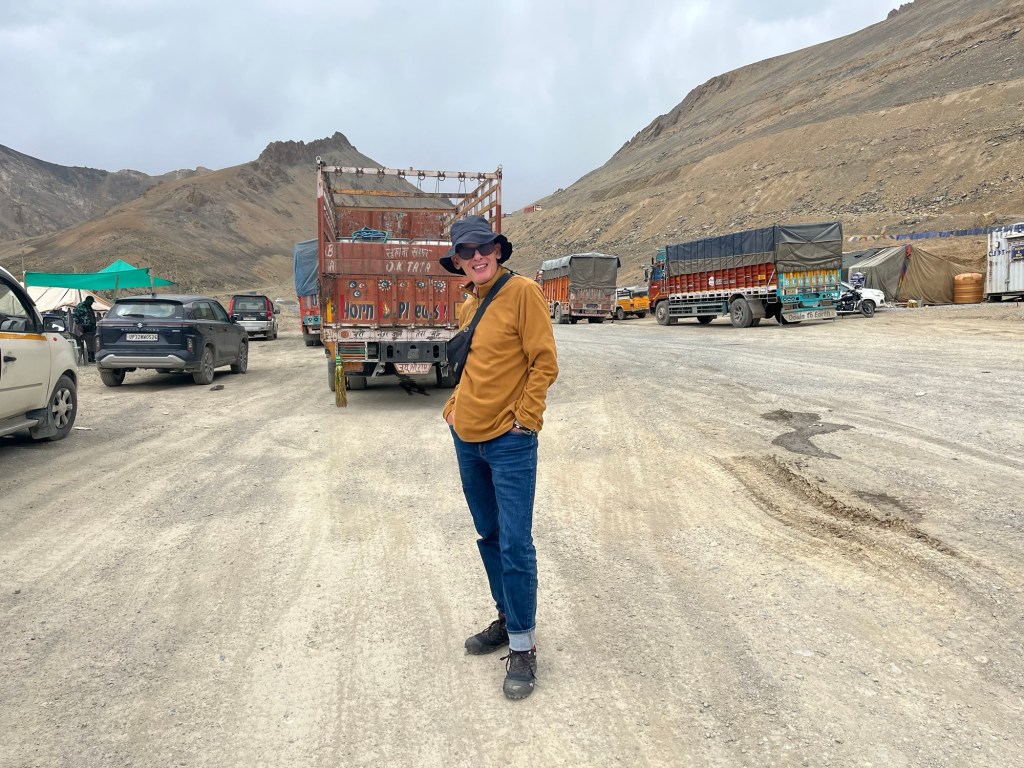
I have put a clip of our journey on Facebook and Instagram. It was an experience that I am very glad we took the opportunity to experience. We both felt well throughout and could enjoy the incredible views. In places the road was safe and smooth. At many others we bumped along narrow ledges and held our breath as we were passed by other vehicles. We travelled across three high passes, the highest being Tangling La at 5359 metres and the others being Baralacha La and Lungalacha La. As we approached each pass the landscape became more stark and bare and as we travelled down we spotted the occasional green oasis nestled beneath the walls of rock. Throughout the journey there were views of snow capped peaks.
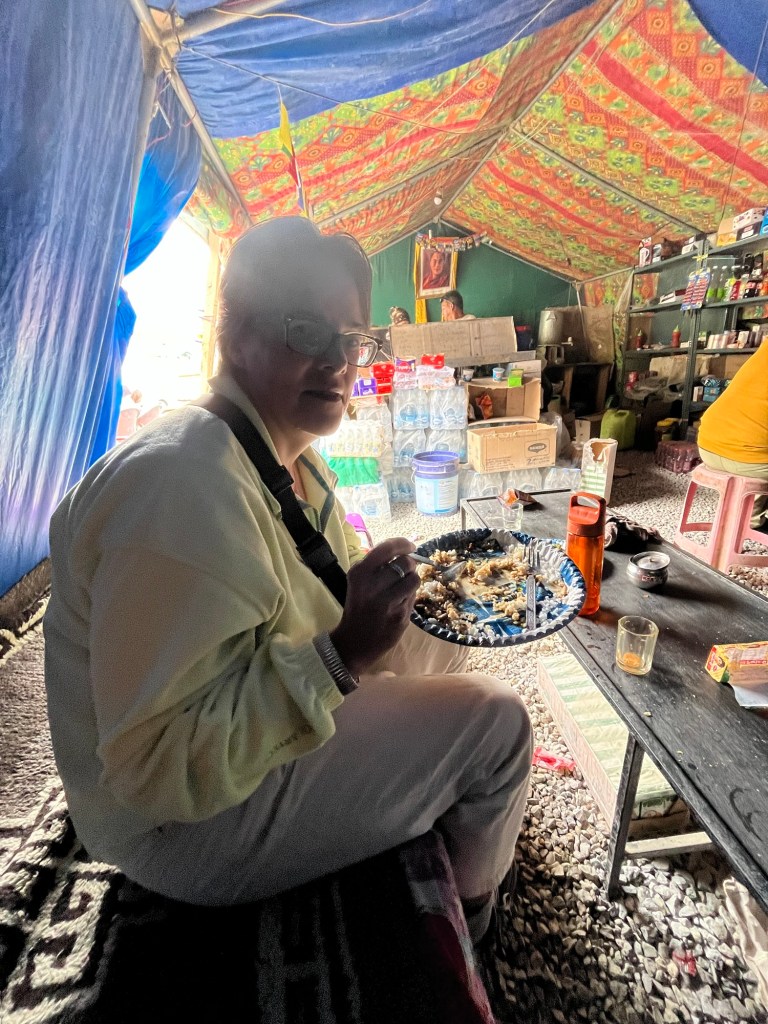
We stopped at various points at dhabas along the way to eat and use the toilets, which although basic were not too disgusting. We were served lunch by a Tibetan man in a tented dhaba, with a picture of the Dalai Lhama displayed on the wall of the kitchen. Despite the basic conditions in the kitchen the bean dhal and rice he served tasted delicious. Many trucks decorated with unique designs as they are all over India and Pakistan were plying the highway, laden down with goods.
We spotted a few road casualties along our way – the ghosts of trucks, stripped of tyres and other useful items on their side halfway down cliffsides. We were also delayed when a small white car that had sped past us earlier in our journey crashed into the verge on a curve in the road. The windscreen was completely smashed. By the time we got there there was no sign of the passengers. I hope they were not killed or seriously injured. A truck and crane were busy removing the smashed carcass from the road so vehicles could pass. These sightings were a salutary reminder of how dangerous the road can be.
We finally reached Leh. Our driver dropped us off at our hotel, which we rolled into, exhausted. We had a big room with a balcony and running hot and cold water, which we luxuriated in. That evening we were too exhausted to go out and ate in the hotel’s restaurant – a home style Indian buffet meal with the ubiquitous dhal, veg, bread and rice. After a long sleep we hoped to be ready to explore Leh.
 Kate's Travels
Leave a comment