
I was slightly nervous about the border crossing from Kyrgyzstan to Uzbekistan. I had read various articles about strict luggage checks and phones being examined.
In fact, the whole process was straightforward. We easily located the correct mashtruka (minibus) – number 777 – at the bus station. There were a few young French travellers on board with us who looked as though they had been camping or trekking. The driver took a note of all our names and passport numbers and we set off.
It was a short journey to the border which is on the outskirts of Osh. We all got off with our luggage to be stamped out of Kyrgyzstan, before returning to the bus. Five minutes later we were being stamped into Uzbekistan. This time we didn’t even have to remove our bags, although guards did check the bus and a sniffer dog was nosing around.
I noticed that we skipped some of the queues that other people were having to wait in. The queue for lorry drivers, in particular, was very long. A lot of empty trucks were passing through from Uzbekistan to Kyrgyzstan. I don’t think our easy passage was due to us being tourists, as there were as many locals on the bus as foreigners (most seemed to be Uzbeks returning home). Our driver was clearly familiar with the process and the border guards so that must have helped.
The only problem with easing through the border so quickly was that we didn’t get a chance to change any money, so that was our first task when we arrived in Andijon. The Uzbek currency has devalued a lot in recent years – we soon realised we needed high denomination notes or we would end up having to carry great wads of cash around with us. We ended up using some dollars we had brought with us for use in emergency to pay for our hostel. Dollars can be obtained from some ATMs in Kyrgyzstan and Uzbekistan, but I am not sure whether you get them at a reasonable rate.
Andijon is a town that is a jumping off point for the Fergana Valley and the Silk Road Towns of Tashkent, Samarkand and Bukhara. It is reputedly the most religiously conservative area of Uzbekistan. It is the birthplace of Babur who went on to found the Mughal empire, so our travels here would join up the dots to our visits to Delhi and Lucknow earlier this year.
Andijon is notorious for a massacre which occurred in 2005. This followed protests against the government which were said to be initiated by Muslim fundamentalists (although there is controversy about this).
As soon as we set out to find some lunch we experienced the legendary friendliness of the Uzbeks. People here are keen to approach us, find out where we are from and practice their English. This occurred much less in Kazaksthan and Kyrgyzstan where people seemed more reserved. We soon found our way into a local canteen style cafe where we randomly picked some noodles from the dishes being served. They were delicious.
There are lots of Turkish restaurants in Andijon – as there are in most of the places we have visited in the Stans. They tend to be a bit pricier than local food cafes, but are nice to sit in for a while. We visited one that evening for dinner. The languages of almost all of the Stan countries are Turkic – to such an extent that the Turkish man (living in Amsterdam) who was on our tour in Kazaksthan could communicate fluently with the locals. He told me that the only non Turkic based Stan language is that of Tajikistan.
After lunch we attempted and failed to get local SIM cards. I bought an eSIM via my Airalo app that runs on the Beeline network, because I didn’t want to bother with hanging around any more mobile phone offices, but it isn’t very effective. Tim managed to buy one later at a UCell office. They claim to have the fastest connection in Uzbekistan and that does seem to be the case from Tim’s experience.
The next day we set out to explore the town. We checked out a local market, which like the ones in Osh, Bishtek and Almaty, sold everything a person could possibly need. There is a very large market on the outskirts of Andijon that can be accessed via mashtruka, but we didn’t have time to visit that. We ate some fried Samsa and drank cherry juice for breakfast in a market cafe. Samsa are ubiquitous here and in other Stan countries. They seem to vary from fried to baked varieties. The baked ones are a bit like Cornish pasties.
After our heart healthy breakfast we needed some exercise and walked to the Devonaboy Masjid, which has been built in recent years and is the main Friday mosque in town. We couldn’t go inside but admired its exterior.
We also visited the remains of the Jome Mosque and Medressa, the only historical building to survive the devastating earthquake of 1902. Due to an unusual local campaign the one remaining 700 year old minaret of the ancient mosque has been preserved (it had been threatened with demolition according to Lonely Planet). There is a museum about Babur’s life that can be visited, but by this time we were flagging and decided to look for a coffee shop.
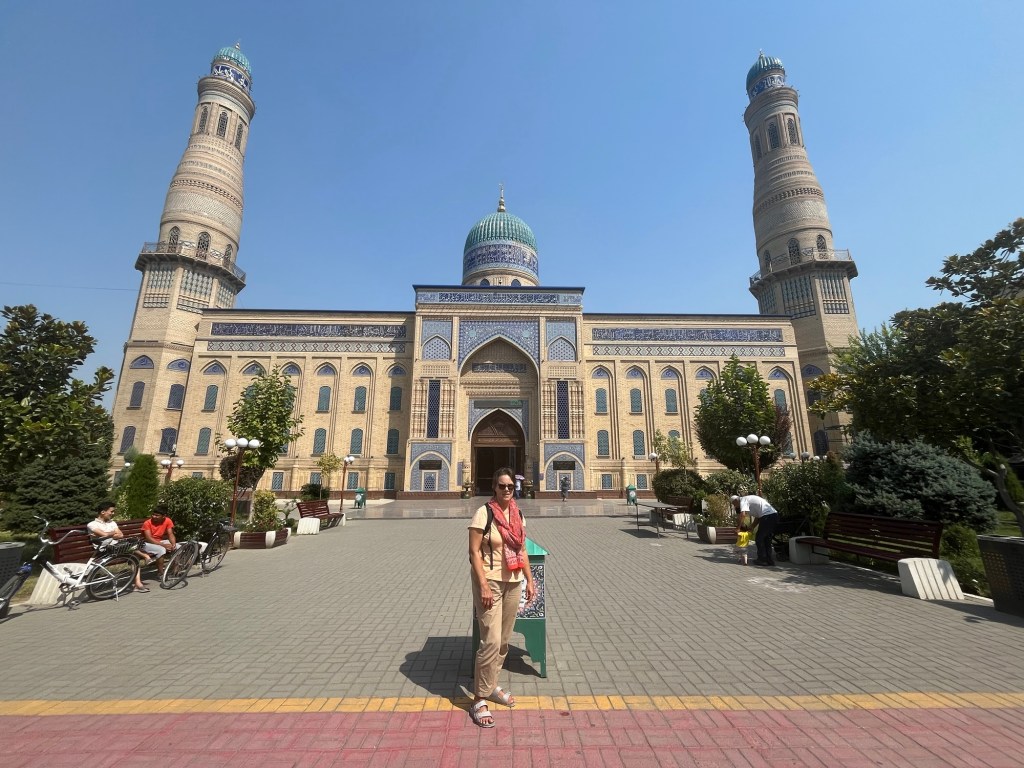
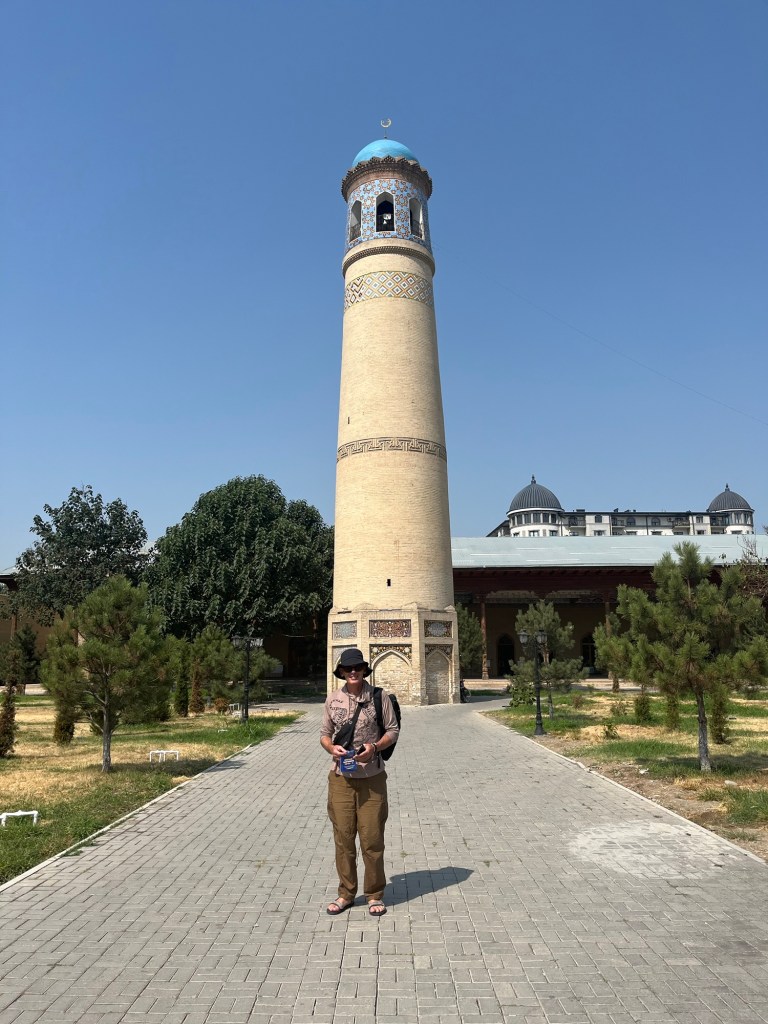
There didn’t seem to be many coffee shops in town, but we managed to find one, ‘Beango’ (gedddit, yes apparently they do have bingo in Uzbekistan) that some entrepreneurs have set up. Their cappuccino was very good. They were hoping to attract more foreign tourists in future.
We had to leave very early the next morning to get the train to Tashkent, so after our coffee we returned to our hostel for a nap and an episode of ‘Empire’ that discusses the Russian conquest of the area we are travelling in. I recommend this podcast (presented by William Dalrymple and Anita Anand) to anyone who is interested in any of the countries we have been travelling through this year. After that we had dinner (another Turkish meal) and an early night.
We were booked on the 6:11 train the next morning. Our tickets mentioned registration closing for the train half an hour before departure, so we got to the station unnecessarily early. We sat and drank coffee and ate Samsas sold in the station canteen while we waited to board.
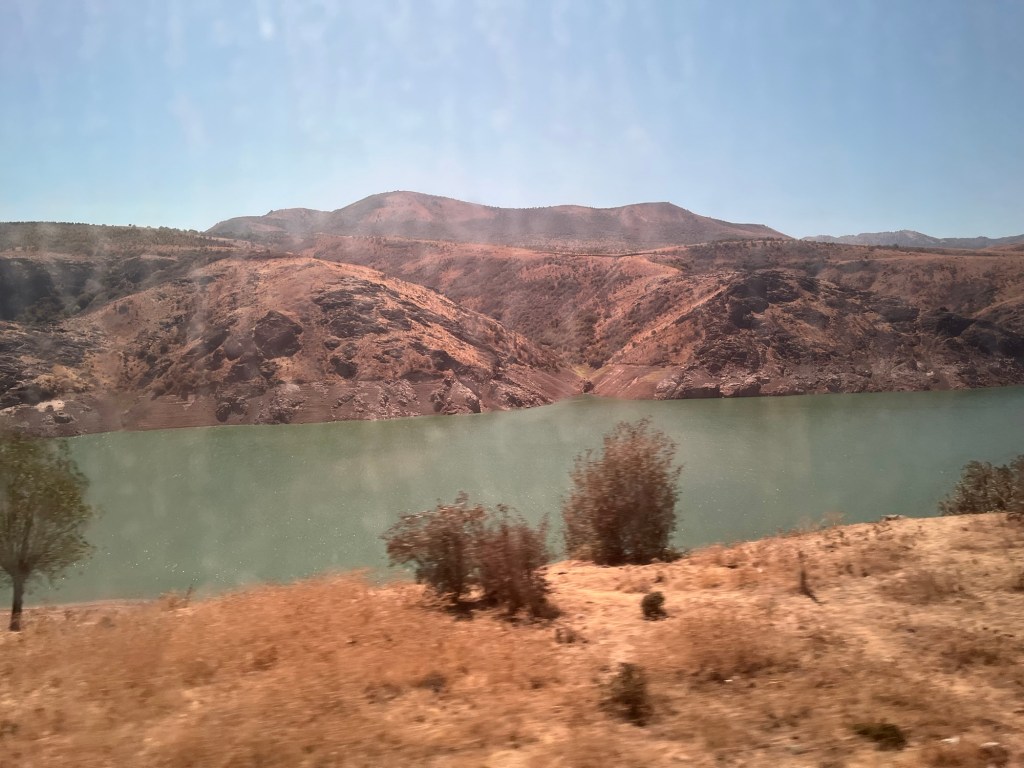
The train whisked us off on a six hour journey via the Fergana Valley. Once we left the valley we climbed into bare, rocky mountainous countryside before heading into Tashkent. The original rail route between Andijon and Taskent was part of the trans- caspian route built by the Russians to link up strategic towns within Central Asia. It reached Tashkent in 1890. However the modern route we followed is called the Angren-Pap railway. It includes the longest tunnel in Central Asia – 19.2km long – through the mountains. We only had a very small taste of the Fergana Valley area, but it’s somewhere I would love to return to some day.
 Kate's Travels
Leave a comment