
It only takes a couple of hours on the train from Bhubaneswar to Puri. The journey was on a local train so it was crowded with no air conditioning, but we did at least have our own reserved seats. We met some Indian students who we chatted to on the journey which made the time pass quickly.

When I booked our hotel at Konark I thought that it was a short walk from Puri – in fact it is an hour’s ride on the bus. We decided to have a quick look around before we continued on to Konark. We headed in the direction of the beach. My hopes were not high as I had read that it is impossible to swim at Puri, due to the treacherous currents. I had also heard that the beach is not particularly clean. All of that is true, but it was fun to see Indian families happily splashing around fully clothed in the large waves. Camels trudged up and down, their owners trying to persuade people to have a ride. I have an aversion to the creatures since I did a camel safari in the dessert in Morocco and ended up with a very sore bum. We felt like minor celebrities as people approached us to ask if they could take a photograph with us. Puri is one of those places that were on the hippie trail in the sixties but there is little trace left of those days now.
We couldn’t take it on the hot beach for too long so after a quick paddle we headed for a small cafe and ordered Thali before heading for the bus station. It was a classic Indian bus ride, cramped and uncomfortable, with the conductor squeezing as many people as possible onboard before we left. The journey along the coast to Konark only lasted an hour though.
The few good, reasonably priced hotels in Puri and Konark were already booked by the time I looked on booking.com and I was slightly worried about the quality of the hotel I had booked in Konark. We were greeted by the son of the owner. He said his Dad was attending a wedding (it was wedding season in Odisha – possibly the reason I had found it hard to find a hotel). The boy was wearing a cap with a massive silver cannabis insignia. He immediately started to try and persuade us to book a taxi to take us to a local lake. He did not get a good response from us in our tired state.
The room was ok, with a new air conditioning unit, although the attached bathroom was a bit grim and got grimmer the longer we were there as the shower became blocked up (we did ask them to fix it but they didn’t). It reminded me of the rooms that I stayed in when I first travelled to India in the mid 1990s and early 2000s. In those days I could manage with very little, but nowadays as a minimum I need the room to be clean, the bathroom to function properly, the bed to have a top sheet (we used our sheet sleeping bags which we have only needed a handful of times on this journey) and there to be mosquito netting on the windows.
The proprietor returned from his wedding the next day and was very friendly and pleasant. He offered to put our laundry in his washing machine for free which was very nice of him and somewhat made up for the room. If he had arranged for the bathroom to be given a good scrub it would have been even better.
Although the Konark sun temple was an amazing monument, Konark itself was a dusty, unpleasant town. I got the impression that outsiders had developed a very limited area around the sun temple (maybe from money obtained due to it becoming a UNESCO Heritage monument?). There was an Indian Oil building that housed the town’s only plush hotel, but it was unclear whether this was open or not. It had an attached restaurant, which was reasonably priced. Tim and I ate there a couple of times. The restaurant/ hotel was in a kind of enclosure that also included a crafts market that nobody except us seemed to visit, an exhibition about the sun temple, some gardens and another cafe that never opened.
The local traders appeared to have been pushed out to an area around the bus station where there were a collection of dhabas. We ate some lunchtime thalis there and they were good, The path leading up to the temple was filled with the usual collection of stalls hawking various souvenir goods. Small groups of destitute people slept on the side of the road. It was the only place we had been so far in India that I felt slightly threatened at night. The owner’s son told us that we were right to be careful – apparently the town is full of brothels and I later found accounts of young girls being kidnapped, held and raped in the town. It had an overall air of despondency and lack of hope about it. It seemed to be a place that tourists passed through and visited for the day, taking in the sun temple, getting back on their tour buses and leaving. This must leave the locals feeling frustrated and cheated. Tim and I were stuck here for three days and four nights, so we decided to make the best of it.
We spent one day visiting the sun temple. It was packed with tourists and just as on Puri beach, we were in demand for family photographs. The temple is thirteenth century and is the culmination of the development of the temples built in the area of Bhubaneswar/ Puri from around the 8th century onwards. The temple is shaped like a chariot (the chariot of the sun God Surya) and you can see the stone wheels on the sides of the building. Apparently when the sanctuary was still in place the morning sun would light the statue within up. The British filled it with stones to prevent it from completely collapsing as it was already in ruins in Victorian times. Nobody is one hundred per cent clear about why people stopped using it, but there are lots of legends about it. We watched a good film about these and the temple’s history in the Indian Oil exhibition centre near the temple. My favourite legend (though it is rather tragic) is the one about the son of the chief temple builder throwing himself off the temple into the sea to die. He had volunteered to put the keystone in place when nobody else could manage it, but the workers were then worried that they would be punished when the king found out that a young boy had managed what builders could not. The boy threw himself to his death to save everybody else.


The temple is no longer on the shore, it is a good 30 minutes walk inland. The sea has receded, just like it has in the Rye area in the UK. It must have been magnificent sight when it was newly built. It is covered with erotic sculptures. Maybe that’s why there’s an active sex industry in Konark? They are very intricate and detailed, in the tantric tradition. It has aspects of other Indian temples I have seen, while at the same time being completely unique. Despite the beauty and mystery of the temple, it was not my favourite in India. It was too flooded with people to properly appreciate. Although they were not nearly as grand I preferred the temples in Bhubaneswar that we visited.
We took another day to go on a day trip to Puri, wander round the shops in the old town, walk along the beach and visit the Jaganath Temple. We also fuelled up on bakery goods and coffee at a very good cafe we found there.
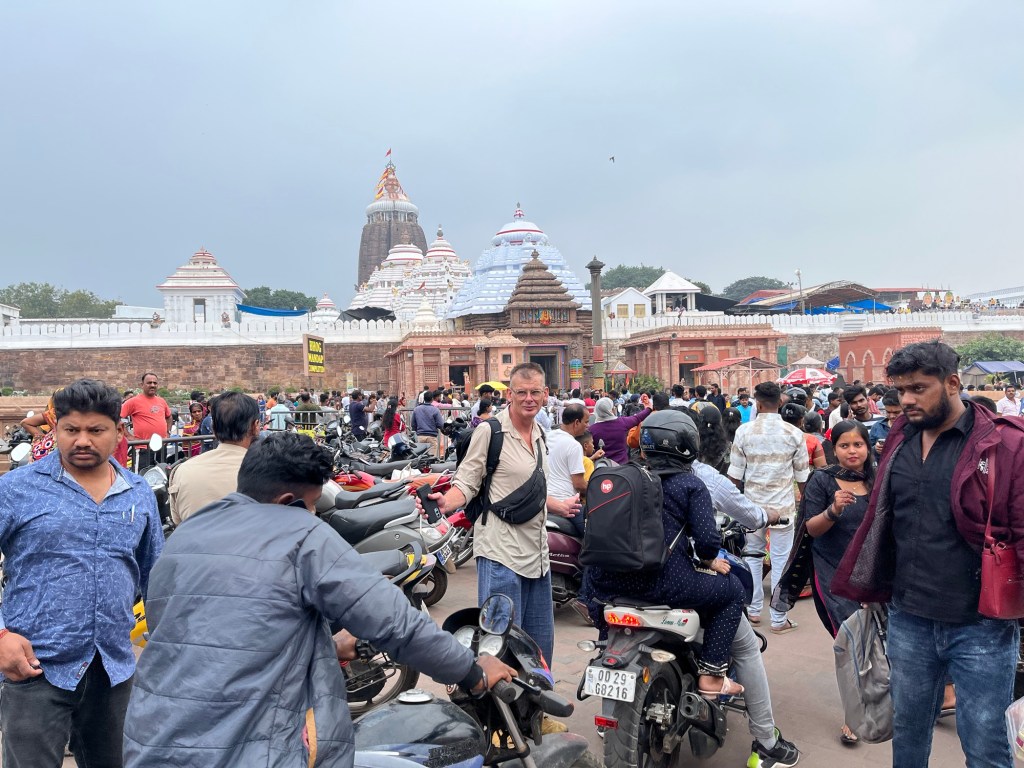
The Jaganath temple was built in the eleventh century. Like the Lingaraj temple in Bhubaneswar non hindus are not allowed to enter the temple, but can only view it from the outside. According to Lonely Planet there is a viewing platform, but we couldn’t find it. We managed to see quite a lot by walking around the temple perimeter. We observed the crowds of people coming and going and the small shrines at some of the temple entrances. The scene at the front entrance to the temple was a classic, chaotic Indian one, with thick crowds of people pushing and shoving, cows, bicycles, dogs and priests passing by, groups of musicians and even at one point a group of men carrying a bier with a dead person on it. I believe there are cremation grounds at a location quite close to the temple on the seashore.
We had another wander along the beach and found a quiet secluded area with a pay to enter beach. We didn’t bother to stop. When we passed the ‘sewage works’ where raw sewage was flooding into the sea, we were glad that we had missed out on any beach activity. Yes, Southern Water are not great, but at least that infrastructure exists in the UK.
I had developed a cold by our last day in Konark, so we took it easy just visiting the archeological museum. We considered going to the local beach at Konark that is meant to be cleaner and wilder than Puri beach but decided against it in the end. The next day we headed back to Puri and Kolkata. Tim had a cold by now as well. It looked like we would be ending our stay in India like we had begun it – ill with cold viruses!


 Kate's Travels
Leave a reply to Smitha V Cancel reply