
We had a one night stay booked in a Hanoi hotel that we had used before on our return from Halong Bay. It was basic but cheap, so fine for an overnight. When we arrived at around 4pm our room wasn’t ready. On further investigation it was full of workmen replacing the entire floor. Although the front desk assured us that the workmen would be gone within the hour, when Tim consulted them they told him it would be a minimum three hour wait.
By this time I was booking another hotel across the road on booking.com, so the problem was solved. Tim pointed out that this proved his long standing argument that we shouldn’t book anything ahead but just check out the places recommended on booking.com once we arrive. He is nostalgic for the days of old school travelling. I remember lugging heavy rucksacks from hotel to hotel and very occasionally having to put up with some bedbug infested hole because nothing else was available. The argument will run and run.
Although our room was fine, the air con unit was right opposite our bed so it was blowing in my face all night, a hazard common to tropical travel. I woke up bleary eyed at 6am – a bus was picking us up at 6:40 to take us to our next destination, Pu Luong. After napping for most of the journey I woke up to stunning countryside on all sides. Karsts covered in vegetation were towering up all around us interspersed with lush green rice paddies.
Our hotel in Pu Luong was slightly more expensive than those we usually book, but it was worth it. Our room was enormous, with a panoramic view onto the rice paddies from the bathroom and towards the mountains from the balcony. There was a good sized infinity swimming pool. We were back in the hills and the climate was much less steamy than it had been in Hanoi.

We spent the day of our arrival hanging around our hotel, swimming and eating. The second day we wandered down to the nearest village. This was along a steep downhill path into a valley. There were views in every direction of karsts, mountains and the endless lush green paddy fields. On our Sapa trek, our guide, Zhou, had shown us how to tell when the rice is becoming ripe. We could see that here it was due to be harvested very soon. I found out later that in the Pu Luong area they have two rice harvests, one in June and one in September.

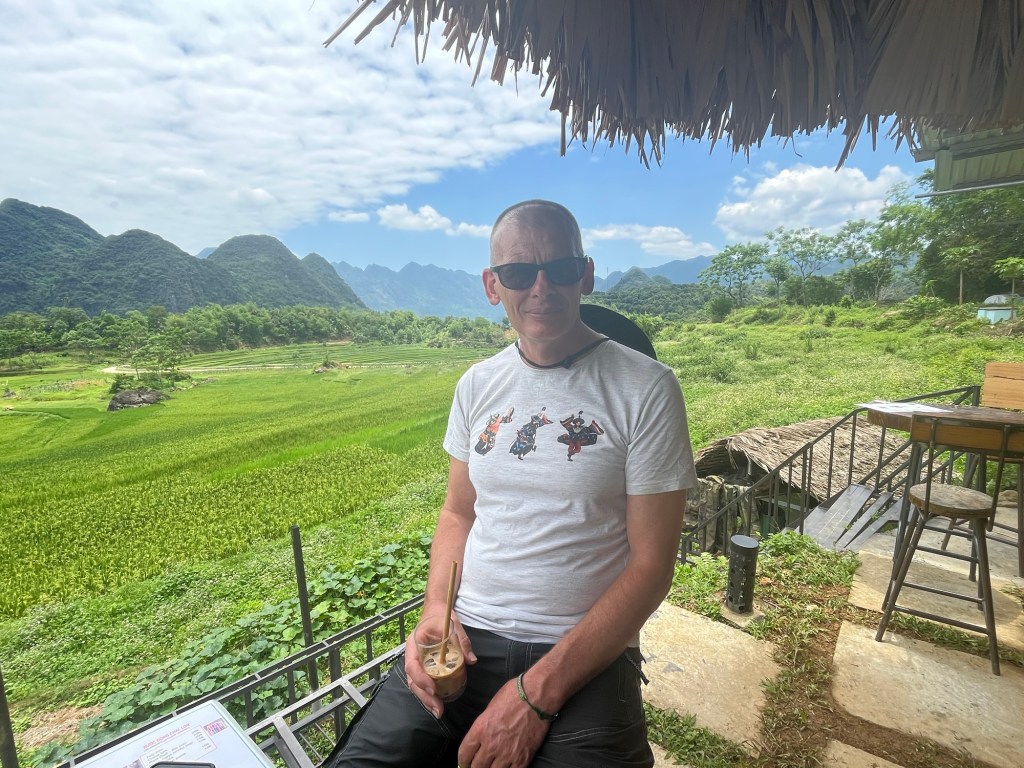
We stopped at a coffee shop for one of the most delicious coconut coffees I have ever drunk, gazing out at the lilac coloured mountains in the distance. Although the area is set up for tourists, with a number of home stays and hotels, it has so far avoided the multi-national multi-storey developments that blight Halong Bay and Sapa. The developments are modest and from what I saw, the local people are still living normal country lives alongside the tourist industry rather than it completely taking over. We stopped at a very basic shop where a middle aged woman was weaving. She showed us how she spins and dyes the thread and then makes it into scarves, hangings and other items. We ended up buying a scarf from her.

The next day we got a taxi to Lang Bang village where the bat cave is. The village is only accessible by motorbike or walking down a very steep path. This has now been concreted and hand rails put in. This has resulted from tourism development in the area, but it has made things more accessible for locals as well. Our taxi dropped us at the top of the steep path and we started our descent. We passed a group of villagers carrying an elderly person completely shrouded in a cloth that was strung on a pole. They explained that this person was very ill and they were taking them back to their village. It would have been too uncomfortable for them to travel by motorbike.
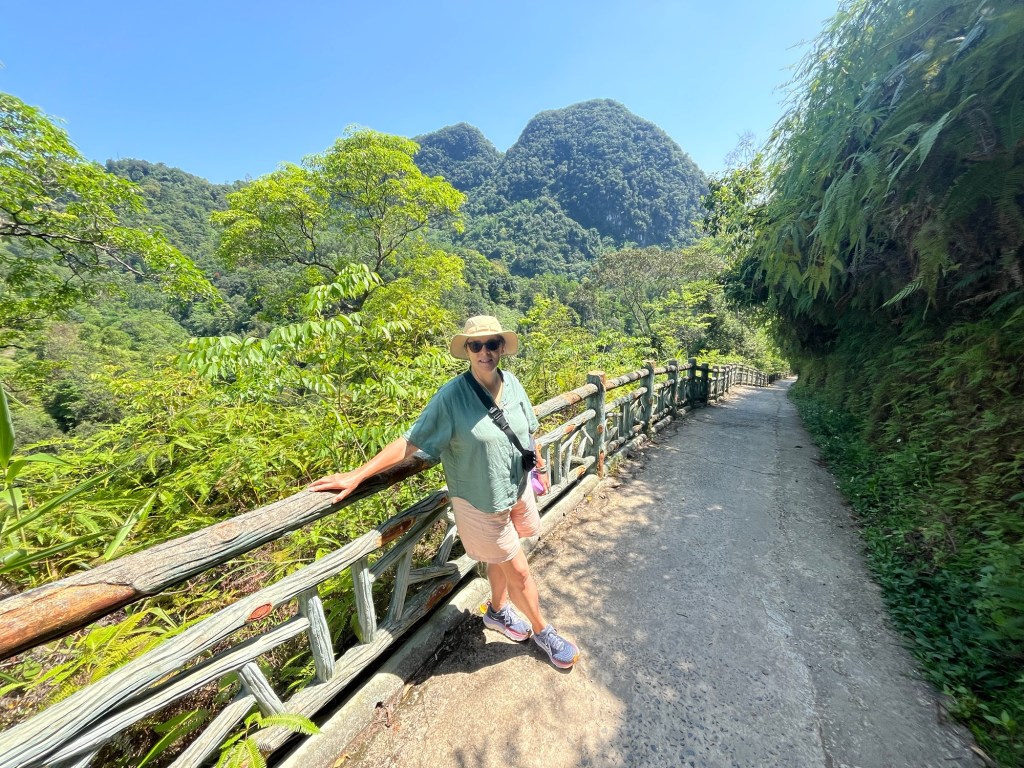
As we descended towards Lang Bang village, which is in a nature reserve, a magical landscape stretched out before us. Ancient moss and ferns grew up on the rocks we walked alongside. We could see the village nestled in the valley among the steep karsts. These protect the village and the shimmering emerald rice fields.

I think that the houses in the village had benefited from money that had allowed recent renovation as they were all looking quite smart. However village life seemed to be carrying on as normal and from what I could see the place had not yet become a ‘tourist village’ like those in Sapa. Chickens and ducks were running around and other animals like cows and pigs were stabled in limestone overhangs at the edge of the village. There were a couple of very simple homestays that I would have liked to have spent a night or two in.
A local resident pointed us towards the bat cave, along a path next to the village stream. A big truck was driving down the stream, scattering ducks before it. A speciality of the area is roasted duck and this flock looked pretty healthy. The truck was delivering sacks of concrete in order for villagers to make improvements to the tourist area at the entrance to the bat cave.

We had to pay a very small fee to enter the cave that a local villager called an ‘environment tax’. I have heard caves called ‘cathedral like’ before, but this is the first time I actually experienced that. Enormous stalactites and stalagmites grew up and down from the limestone floor and ceilings. Ancients ferns and mosses gave the place a greenish ethereal glow. There were steps going most of the way into the cave and the entrance was quite wide so sunlight was able to penetrate. Once my eyes adjusted to the lower light levels it was easy to see around.
Tim ventured further than me down to the cave floor, which is the size of a football ground. Here torches are needed to see the underground caverns that lead from the wide open space and end up as underground lakes and water channels carrying water supplies several miles into the surrounding area. Tim described an enormous seven foot stalagmite guarding the entrance to the water filled underground cavern. He told me that the water lapping against the shore was crystal clear in the light of his phone torch. We could hear but not see the bats. Apparently at least four different varieties of both fruit and insect eating bats have been found living in the cave.
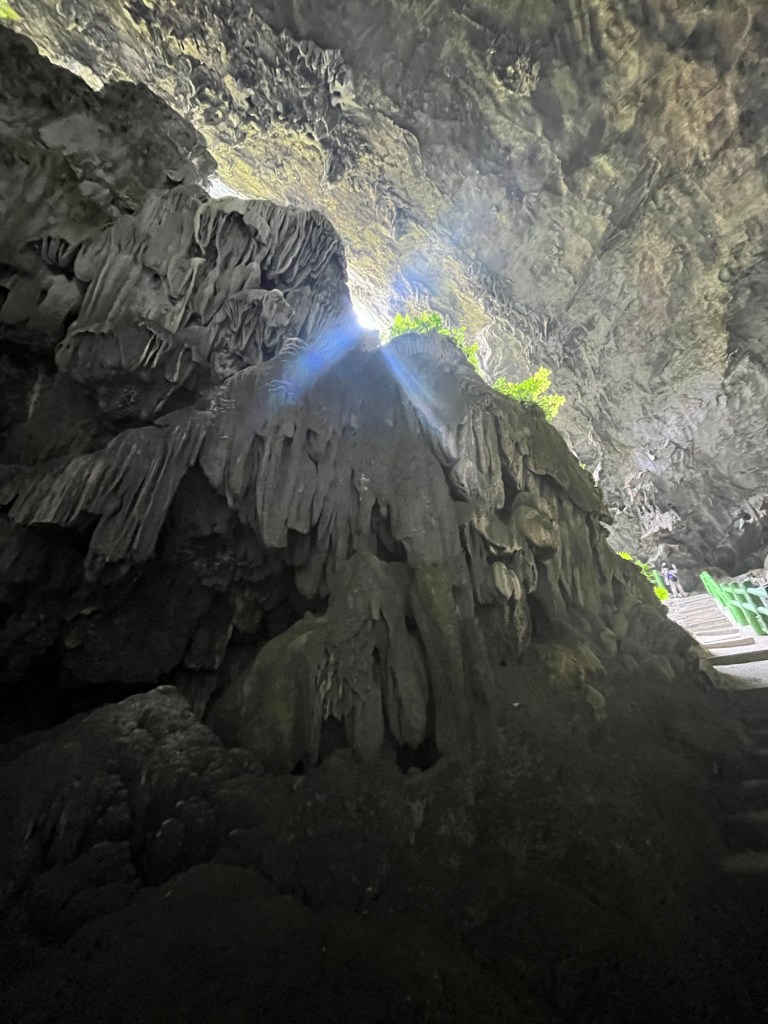

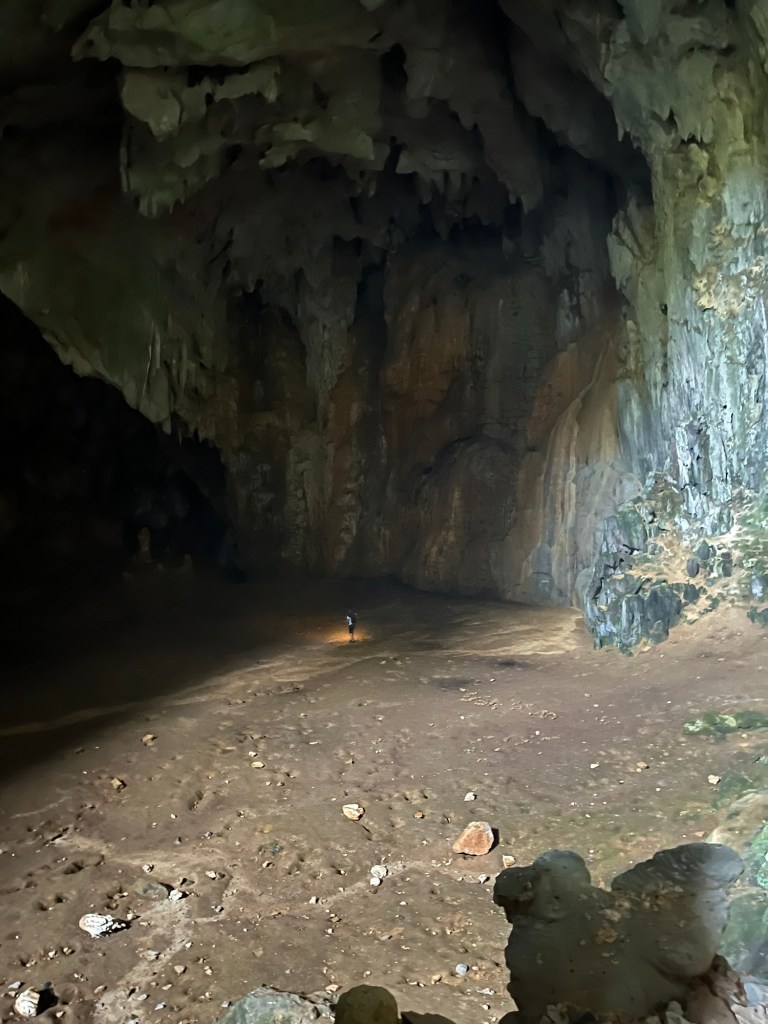
Inside the bat cave – in the last picture you can see the tiny figure of Tim after he climbed down onto the cave floor. I have also put a short video of our journey into the cave and another of Ang Bang village on social media
There was a lot more we could have seen in Pu Luong – for example ancient water wheels and other local villages. We relaxed again the next day though, just wandering around the local area before being picked up the next day to travel back to Hanoi and take an overnight train to Danang in central Vietnam.

Pu Luong turned out to be my favourite place in Vietnam so far and I would love to return there some day.


 Kate's Travels
Leave a reply to changeskaty Cancel reply