
I found out about Indiahikes when I was walking in Hastings Country Park. Tim and I got chatting to a fellow walker, an Indian national who was working as a doctor in the Dartford area. He told us that if we were planning to go trekking in India, Indiatreks had the best reputation and safety record – he had been on some treks with them.

We all had to be up bright and early on our first morning. The routine throughout the trek was black tea at 6am, breakfast at 7am and start walking at 8am, except for the day when we made it to the pass, when everything started an hour earlier. After a filling breakfast we piled into the Indiahikes transport again to be taken to the village where our trek would start.
We had a local guide, Rahul and a trek leader, Suraj. They led us up a steep slope. Then they paused so that Suraj could give us a run down on the trekking we would do that day and take us through some stretches. He was frequently interrupted by villagers walking past with their herds of cows and goats. I had drunk too much delicious Indian tea that morning and was already bursting for the toilet, so Suraj’s information went over my head as I looked around for a discreet location to relieve myself. I spotted a stile that led to an apple orchard just as the trek proper began and told Tim to wait for me. I prayed that I wasn’t poisoning the fruit.
During the course of the trek, Vineeta, Manassee, me and a couple of the other women trekkers bonded over finding suitable toilet spots and watching out for each other while we relieved our bladders in the great outdoors. The situation was of course a lot more straightforward for the men. I bought a ‘she wee’ and have pointlessly carried it throughout my travels. Although many young festival goers swear by them I haven’t been able to bring myself to use it yet.
Our first day’s trek appeared to be quite easy – just three kilometres. However it was steeply uphill and although I could have managed a bit further I have to admit that I was glad when we reached the campsite. Indiahikes is very focused on environmental issues. They promise to leave the trails cleaner than they were before they used them. Every hiker is given a pouch to collect rubbish along the way. The extent of the rubbish we found was nothing like that in Manali but there was the odd discarded crisp packet and sweet wrapper.
Suraj explained that Indiahikes works with a local NGO to recycle what they can and dispose safely of other rubbish. This avoids adding to the Manali landfill which is now overflowing and has become a rubbish mountain. The conclusion is not to buy anything that has packaging. I thought guiltily about all the packaging in my weekly supermarket shop and resolved to use places like Bexhill greengrocers more on my return home. Sadly a lot of the UK’s rubbish still gets shipped abroad and even the stuff that we are told goes to charity often ends up in landfill. Often I have felt overwhelmed by these issues but the message is that small actions together to still have an impact, challenging my cynicism and fatalism.
Suraj told us about a landfill near Pune which I can recall reading about in the news. The whole village became politically activated when their water sources and the air they breathed was contaminated by the local landfill. It got so bad that outsiders would not agree to their daughters marrying into the village.
On our way back down Suraj discovered an area within an Indiahikes campsite where more serious rubbish disposal had occurred, including a sneaker and ironically an Indiahikes rubbish bag. I felt that he was very committed to the environmental ethics of the organisation and would be reporting the lapse in this particular spot and dealing with it.

With Manasee on the first day of the trek
Suraj also provided opportunities for mindfulness activities during the hikes such as spending time walking silently through the forest so that people could listen to nature rather than each other or their headphones. He was full of information about the natural environment such as the types of trees, berries and plants.
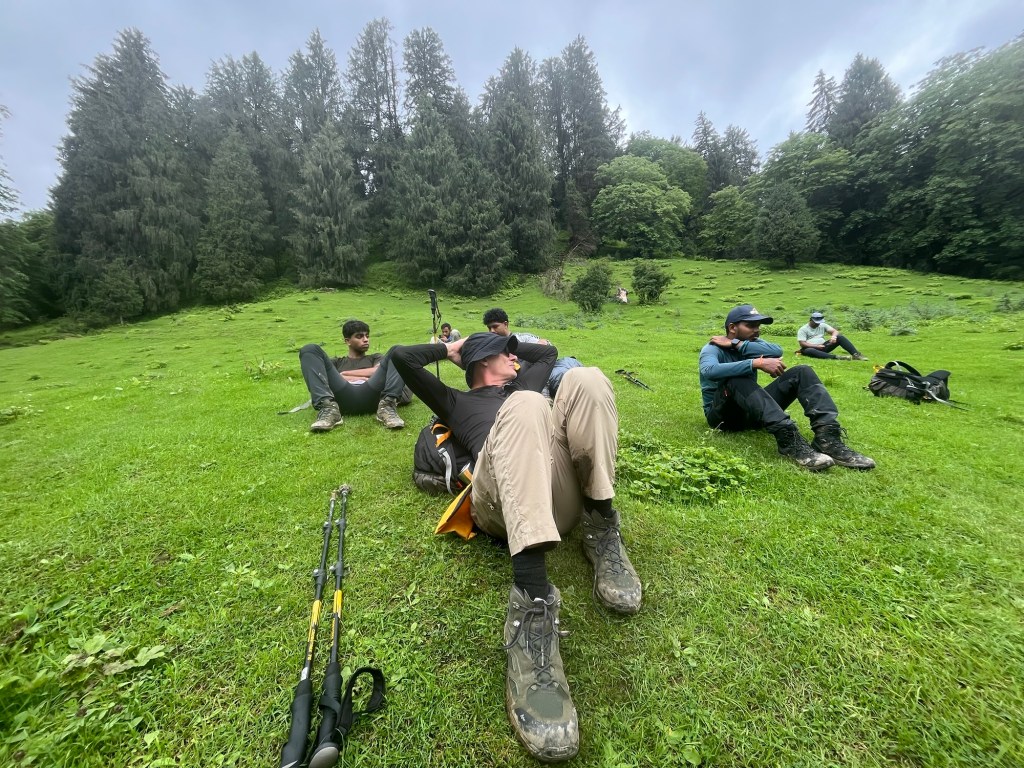
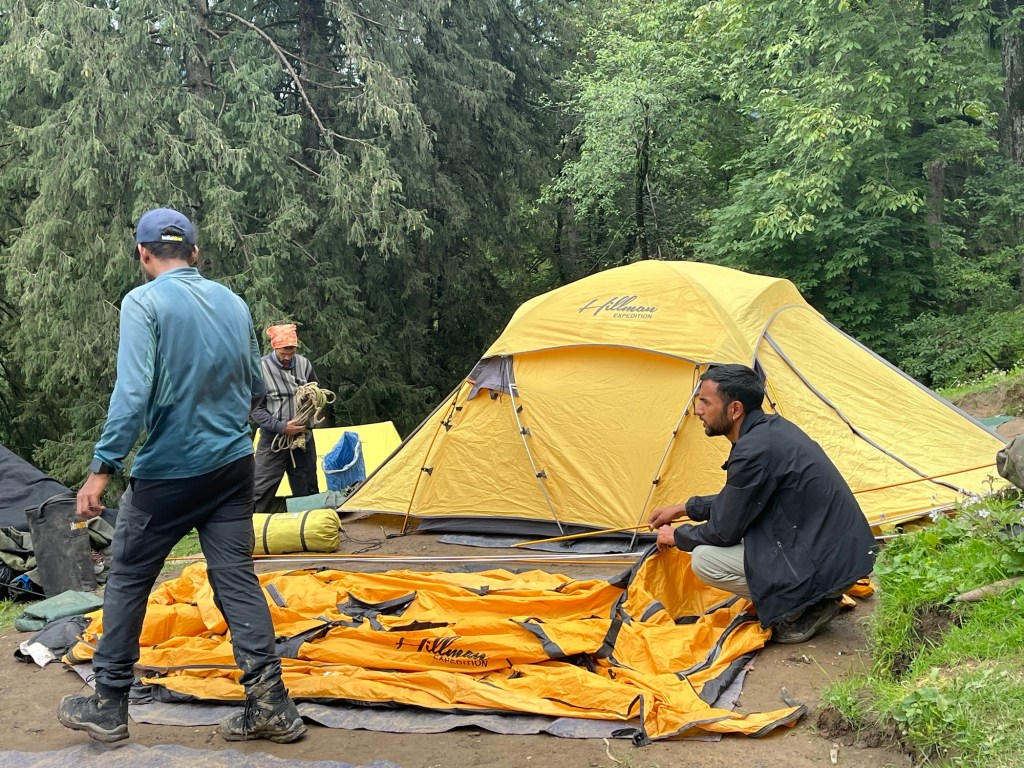
Our first days’s hiking was mainly through a wooded forest area with a great variety of ancient trees. We rested at a beautiful meadow before trekking further to another meadow area where we were to camp. Suraj told us that today he would give us a demonstration on how to put tents up. The Indiahikes philosophy is that everyone should hike and a hike teaches people the skills they need to trek independently with their friends. Luckily Tim was in my group, as my talents are not really showcased in practical areas such as putting up tents. In fact I am more of a hindrance than a help even when taking direct orders. As we began to put the tent up it started to rain, which didn’t help. We finally managed it and were allocated tents to sleep in. I was relieved that as the tents were two person, I would be sleeping with Tim. We were all getting wet by this time, so after ensuring our bags were safe we headed for the communal mess tent.
The food on the trek was excellent. I don’t know how the cook managed to produce such delicious food in such challenging conditions. We had three full meals and two snacks per day throughout the trek and it was all delicious non-oily vegetarian Indian food. Usually our main meal consisted of some sort of dhal/ beans plus veg, rice and a chapatti. We also had noodles and delicious pasta with white sauce as snacks at 5pm (the evening meal was at 7pm) but they were more like meals in themselves.
Unfortunately, on the first day, Tim and I discovered that we had water in our tent as the sleeping mats had got wet in the rain shower, but we managed to dry them out on top of the tent when the sun came out later that afternoon. Tim was feeling ill with a headache. I wasn’t sure whether this was to do with the altitude or was just one of his normal headaches, but Suraj was keeping an eye on him. We had to take our oxygen levels and pulse rate every morning and evening.
The toilets on the trek were dug by the camp assistants who carried the tents, bedrolls, food etc on mules. Essential oil scented sawdust was provided. They didn’t smell too bad as we only used them for one night. However in every single campsite they were located quite a way from the sleeping tents. I managed to stagger my liquid intake to avoid having to get up too much in the night.

The next day Tim was feeling a bit better and revived completely after I gave him an aspirin/ paracetomol/ caffeine tablet, which made me suspect that his headache might have been partly due to coffee withdrawal – there was none provided on the trek, although we did drink a lot of Indian chai.
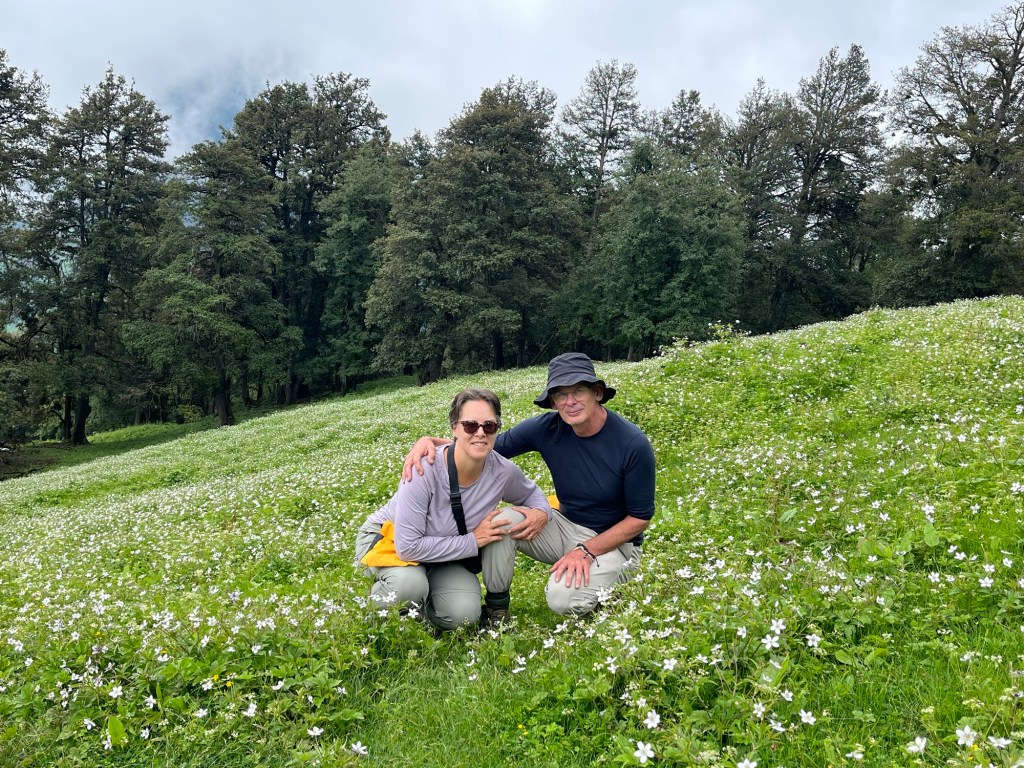
We walked slightly further – 5.5km – on our second day, As this was a beginners/ moderate trek the pace was nice and slow. We passed through another gorgeous alpine meadow, this time studded with white flowers in every direction. Our campsite that night was at 3465 metres. I wasn’t too impacted by the altitude, other than feeling a slight tense band around my head and eyes. In keeping with the Indiahikes philosophy Suraj had delegated all the trek leader’s tasks to members of the group and people had volunteered to take on various jobs. I and Manasee said that we would be water monitors which just involved reminding people to drink. I think Tim got away with not having to do anything. A couple of the younger Indian men who were keen trekkers took on the leader roles, but Manasee, Vineeta and I were quick to complain when they tried to make us all walk too fast. There was a young seventeen year old walking with her brother who was struggling a bit, but with everybody’s help she managed to complete the trek.


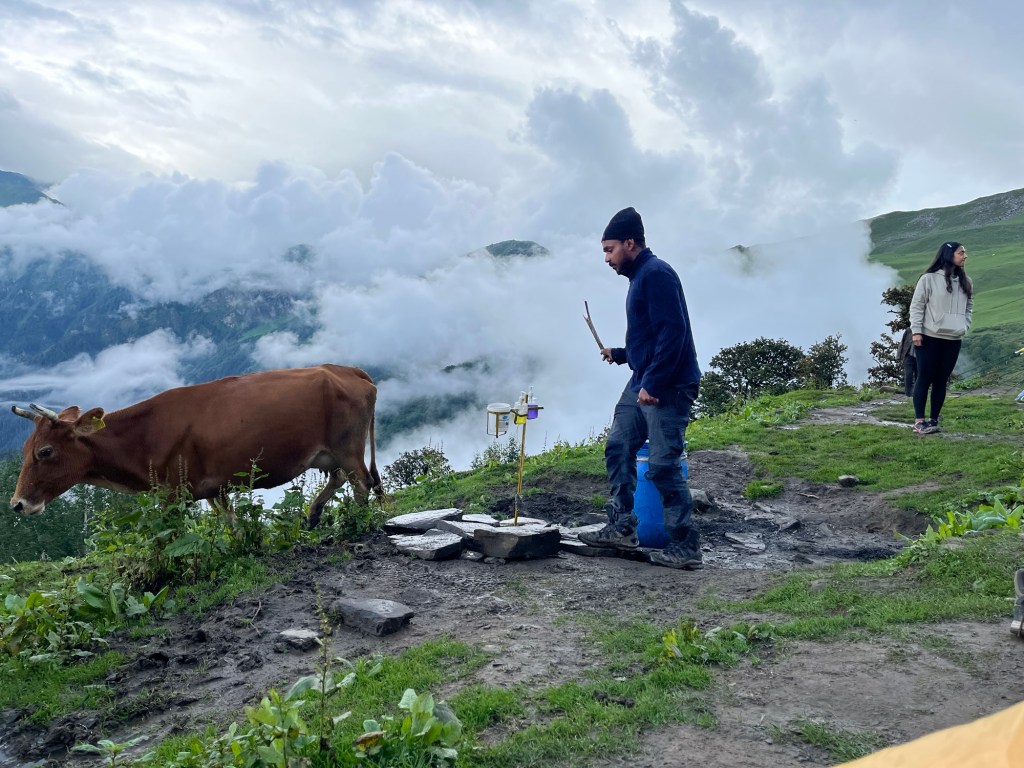
On the evening of our second day, like our first day, the views of the mountains were spectacular. We had a cow invasion by one particular madam who had scented the pail where the food scrapings were kept and was determined to finish them off. That night both I and Tim both slept reasonably well.

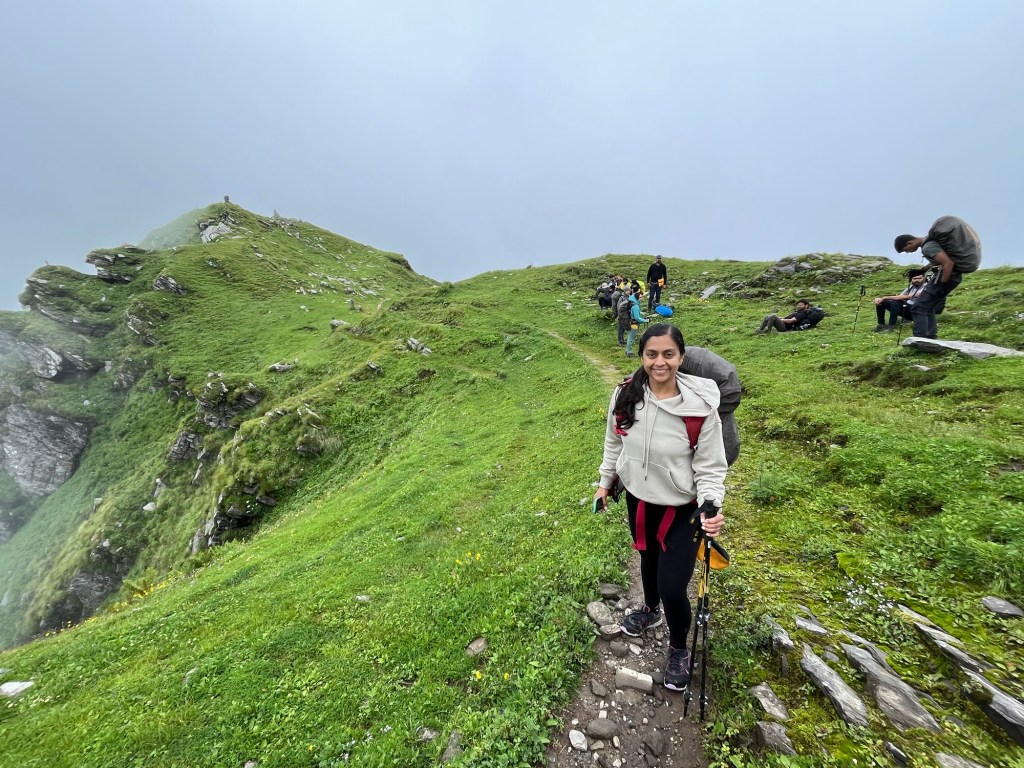
On the third day we walked the 3k up from our campsite to the Chanrikhani pass. We stopped and spent some time there. Although we got some good views of the mountains on the way up, the clouds had moved in by the time we reached the pass, so the view was obscured. On one stretch we walked along a ridge and the views would have been wonderful on both sides without the cloud cover.
The pass had a magical feel to it even without the views – similar to somewhere like Stonehenge. There was a simple goddess temple which we were not allowed within a certain distance of as we would pollute it. Our guide Rahul, who is local, headed over there. I noticed a lot of standing stones. Rahul (translated by Manasee) told me that the local people put them there in order to ask for things from God. All the local villages bring their village temple idols up to the pass at certain times of year, so that the spirit/ idol on the pass can bless them and give them its power.


Suraj did a mindfulness exercise at the summit where he gave us all a postcard which we had to write messages to our future selves on. I had had a couple of teary moments, thinking about my Dad, who loved walking and had spent time with friends climbing in the alps as a young man. He would have loved to have done this trek.
We began to head down, past the place we had camped during the night to a lower campsite. In total I think the distance we walked that day was around 9 – 10 kilometres and other than going up to the pass it was mainly downhill, which made it a bit easier. It was very muddy and slippery in parts though. I was very glad of my walking sticks, which I have not used before but turned out to play a big role in stopping me taking a tumble, especially after Suraj showed me how to use them properly.
We all felt a sense of achievement that night and Suraj led us on an exercise during which we reflected on our experience of the trek and what we would take back into our normal lives from it. The cook also made a cake for us to celebrate, which was delicious. Manasee told me she thought he made it in a pressure cooker.
The next day we faced rain while descending to the place where the transport would pick us up and take us to base camp. There were several very steep and muddy sections which were potentially hazardous, so we took things slowly. Several people took a tumble at various points, but luckily there were no serious injuries. We were all looking forward to having showers and putting on clean changes of clothes. It hadn’t been possible to wash properly at all during the trek. We finally reached base camp, where we had lunch, handed back our hired goods and said our goodbyes before being dropped back off at Beas Bridge in Manali. Tim and I headed back to our original hotel and used up all the hot water in the immersion heater. It had been an unforgettable experience, one of the best in our year so far.

 Kate's Travels
Leave a reply to lizmeyer60yahoocouk Cancel reply